

Inventory management is one of the most important parts of modern business operations. Whether a company manages raw materials, finished goods, returnable containers, tools, retail products, medical supplies, or industrial assets, inventory accuracy directly affects cost, delivery speed, productivity, and customer satisfaction.
Traditional inventory methods often rely on manual counting, spreadsheets, or barcode scanning. These methods can work for simple operations, but they become slow and error-prone when inventory volume grows, locations expand, or items move frequently. Workers may need to scan items one by one, locate visible barcodes, update records manually, or spend hours reconciling stock differences.
RFID inventory management provides a faster and more automated way to identify, count, and track inventory. By using RFID tags, readers, antennas, printers, and software, businesses can capture inventory data automatically and improve visibility across warehouses, factories, stockrooms, distribution centers, and supply chain operations.
For Syncotek, RFID inventory tracking is not just about counting items faster. It is about helping businesses build a more reliable connection between physical inventory and digital management systems.
RFID inventory management is a system that uses radio frequency identification technology to identify and track inventory items automatically. Each item, carton, pallet, container, or asset is attached with an RFID tag. RFID readers capture tag data wirelessly, and software processes that data into useful inventory information.
Unlike barcode systems, RFID does not always require direct line-of-sight scanning. Multiple tagged items can often be read quickly, depending on the tag type, reader setup, environment, and system design.
RFID inventory management can be used to track:
The goal is simple: know what inventory exists, where it is located, how it moves, and when action is needed.
Manual inventory tracking may seem simple, but it can become expensive and unreliable as operations grow.
Barcode systems improve visibility compared with manual counting, but they still usually require line-of-sight scanning. In large warehouses, retail stores, factories, and industrial yards, this can still create bottlenecks.
RFID helps reduce these limitations by automating identification and enabling faster inventory data capture.
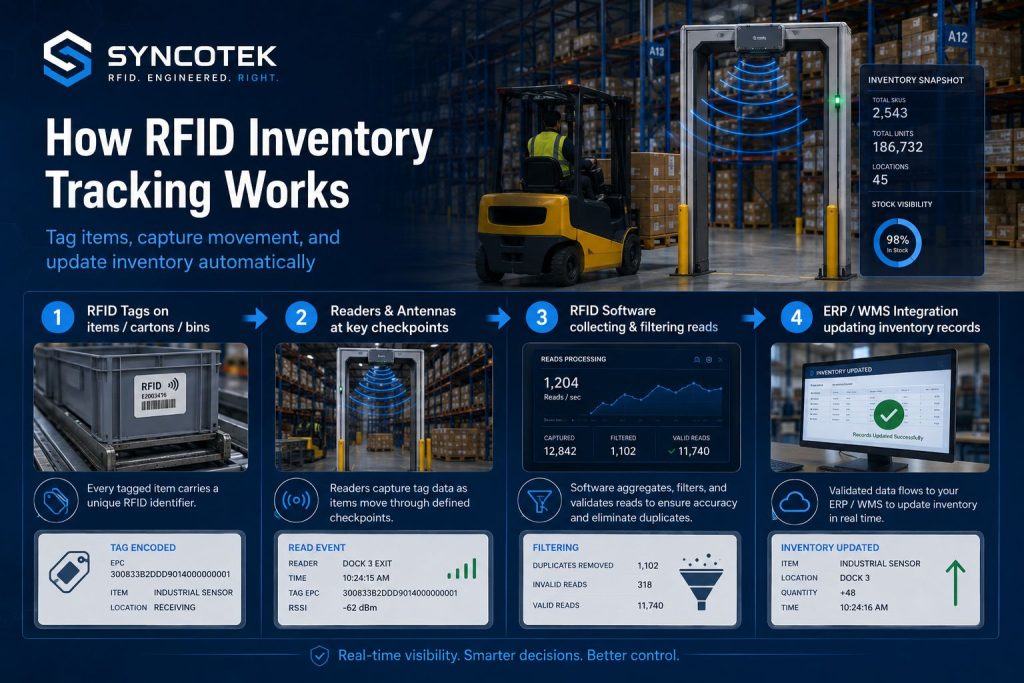
A typical RFID inventory tracking system includes four main steps.
The first step is to attach RFID tags or labels to the inventory that needs to be tracked. Depending on the business model, tags can be applied at different levels.
|Tagging Level|Example Use|
|||
|Item level|Retail goods, tools, medical devices, high-value assets|
|Case level|Cartons, packaged goods, shipping units|
|Pallet level|Bulk inventory, warehouse movement, logistics|
|Container level|Returnable totes, bins, carts, racks|
|Asset level|Equipment, machines, molds, IT devices|
For some businesses, pallet-level tagging is enough. For others, item-level tracking is necessary. The right tagging strategy depends on inventory value, movement frequency, counting requirements, and operational goals.
RFID readers and antennas are installed at key locations where inventory movement needs to be captured.
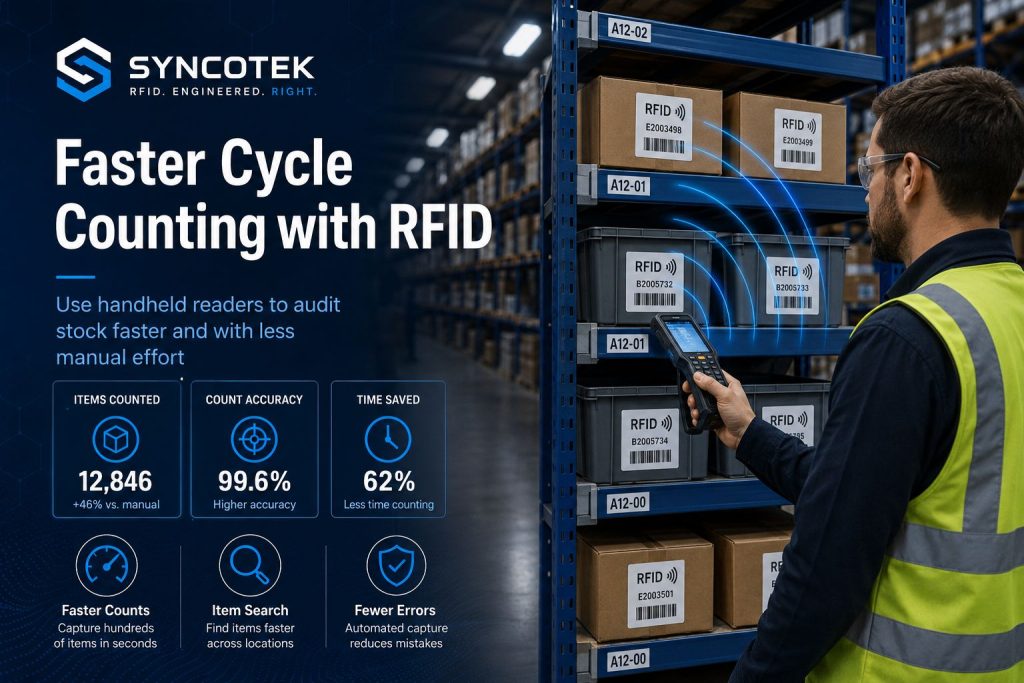
Fixed RFID readers can automatically capture movement at specific locations, while handheld RFID readers can be used for cycle counts, stock searches, and exception handling.
The goal is to collect the right data at the right moment without creating unnecessary manual work.
When tagged items pass through a read point or are scanned with a handheld reader, the RFID system captures each tag’s unique identifier.
This data can be used to record:
Compared with manual counting or barcode scanning, RFID can significantly speed up inventory capture, especially when many items need to be identified at the same time.
RFID hardware creates data, but software turns that data into useful inventory information. RFID inventory software can filter reads, update stock records, generate alerts, support cycle counting, and integrate with business systems.
A strong RFID inventory solution should not only read tags. It should help the business make better decisions.
RFID can reduce the time required for cycle counts and physical inventory counts. Instead of scanning every barcode one by one, workers can identify multiple tagged items more quickly with RFID handhelds or fixed readers.
This is especially valuable in:
Faster counts mean less downtime and more frequent inventory verification.
Inventory errors create real business problems. When records are wrong, teams may order too much, run out of stock, ship the wrong item, or lose time searching for products.
RFID helps improve accuracy by reducing manual entry and automating data capture. When inventory movement is recorded more consistently, businesses can maintain more reliable stock records.
RFID can provide better visibility into where inventory is located and how it moves through the facility.
This helps businesses answer important questions:
Real-time inventory visibility helps teams respond faster and reduce operational uncertainty.
Manual inventory work is time-consuming. Workers may spend hours walking aisles, scanning barcodes, checking spreadsheets, or looking for missing items.
RFID can reduce manual effort by automating routine identification and supporting faster searches. This can help teams focus on higher-value work instead of repetitive counting.
RFID can improve receiving and shipping accuracy by verifying tagged items at dock doors, staging zones, or loading areas.
This helps reduce shipping mistakes, receiving delays, and inventory reconciliation issues.
Poor inventory visibility often leads to two opposite problems: running out of needed items or holding too much unnecessary stock.
RFID helps improve stock visibility, which supports better replenishment planning and inventory control. Businesses can use RFID data to identify low-stock items earlier, reduce emergency purchasing, and avoid tying up capital in excess inventory.
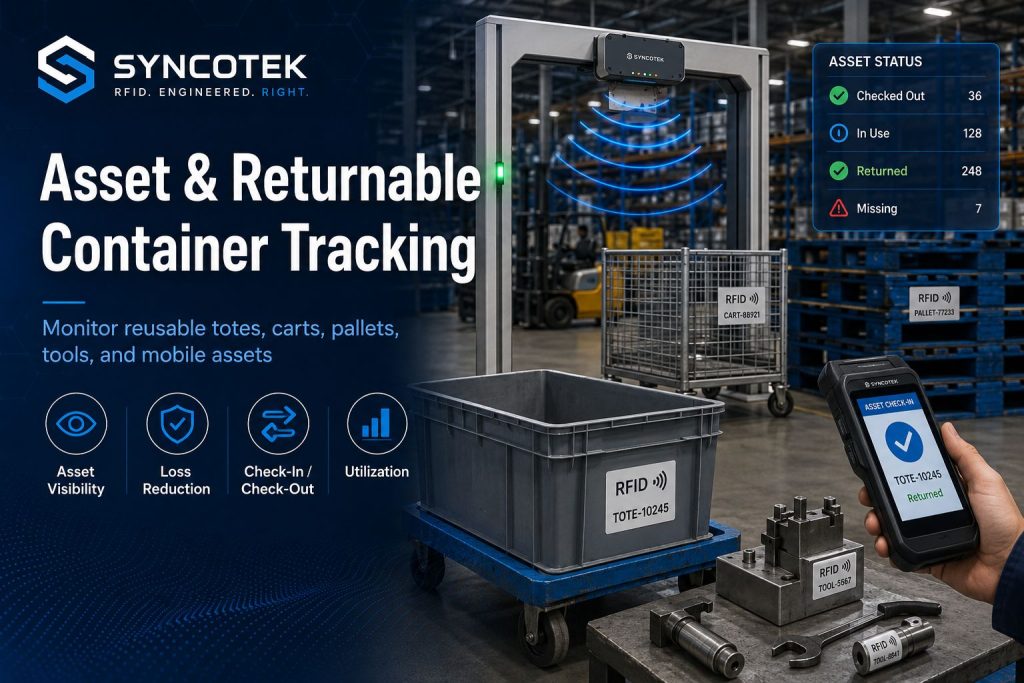
Inventory tracking is not limited to products for sale. Many businesses also need to manage returnable containers, tools, bins, carts, racks, reusable packaging, and high-value assets.
RFID can support check-in/check-out workflows and help businesses understand which assets are available, in use, missing, damaged, or delayed.
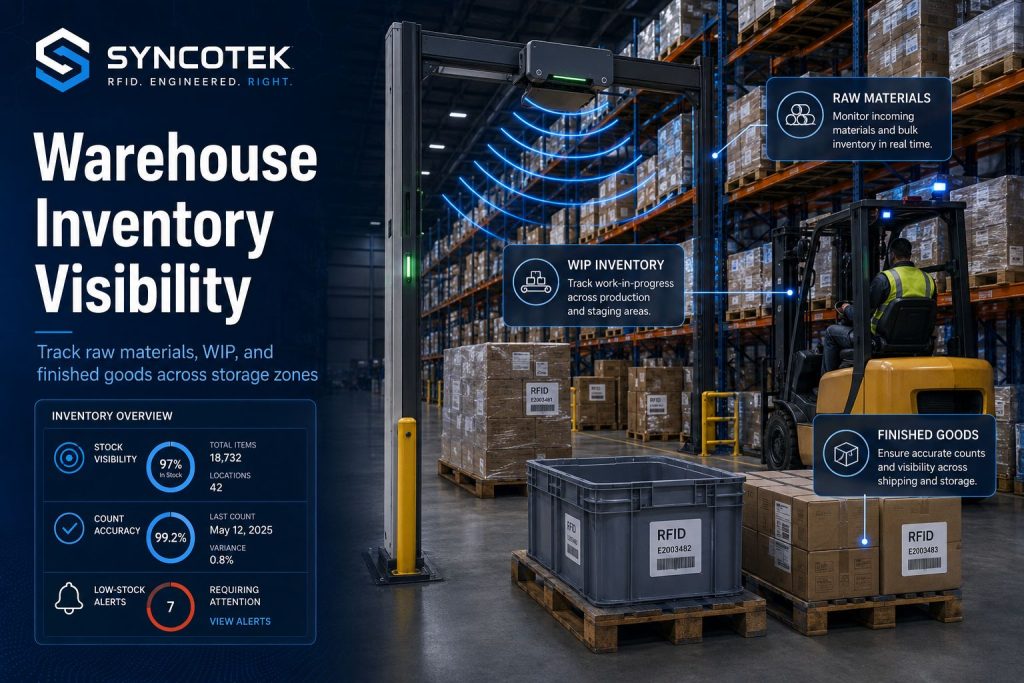
Warehouses often manage large volumes of inventory across receiving, put-away, storage, picking, staging, and shipping. RFID can help automate inventory movement and improve visibility across these zones.
Manufacturers use RFID to track raw materials, work-in-process inventory, finished goods, tools, fixtures, and containers.
For metal tools, machines, racks, or containers, on-metal RFID tags may be required for reliable performance.
Retailers use RFID to improve item-level stock accuracy, shelf visibility, replenishment, and store inventory counts.
For retail operations with thousands of SKUs, RFID can help reduce the gap between recorded inventory and actual available inventory.
Hospitals, labs, and healthcare facilities manage many high-value, sensitive, or time-critical items. RFID can help improve visibility and accountability.
RFID can help ensure critical items are available when needed.
IT teams often manage servers, laptops, network equipment, storage devices, and accessories across offices or data centers.
RFID can make IT inventory audits faster and more accurate, especially when assets are installed in racks, rooms, or restricted areas.
Construction sites, oil and gas operations, utilities, and industrial service teams often need to track tools, equipment, parts, and field assets across wide or harsh environments.
RFID can help improve visibility and reduce loss, especially when combined with rugged tags designed for industrial conditions.
RFID tags are attached to the item, carton, pallet, or asset. The tag choice depends on the application.
|Tag Type|Best Use|
|||
|Standard RFID label|Cartons, boxes, packaging, retail items|
|Rugged RFID tag|Industrial assets, outdoor assets, reusable equipment|
|On-metal RFID tag|Metal tools, machines, racks, IT assets, containers|
|High-temperature RFID tag|Manufacturing, heat treatment, industrial processing|
|Tamper-evident RFID label|Security-sensitive products and assets|
|Printable RFID label|Warehouse, logistics, and compliance labeling|
Tag selection is one of the most important parts of the system. The wrong tag can cause poor read performance, short service life, or unreliable tracking.
RFID readers capture tag data. Different workflows require different reader types.
Fixed readers are useful for automated read points. Handheld readers are useful for cycle counts, item search, and exception handling.
Antennas define the read zone. Their placement affects whether the system reads the right tags at the right time.
A well-designed read zone improves inventory accuracy and reduces unwanted reads.
RFID printers and encoders are used to print labels and encode RFID data into tags. They are especially useful when businesses need serialized labels for cartons, pallets, assets, or products.
Printer selection should match label size, RFID inlay, print volume, material, and encoding workflow.
RFID software connects hardware data with business operations. It can filter reads, update inventory records, generate reports, and integrate with other platforms.
Without software, RFID data remains raw and difficult to use. With software, RFID becomes an operational management tool.
Barcodes are still useful for many inventory workflows. They are low-cost, simple, and widely understood. However, RFID offers advantages when businesses need faster counting, non-line-of-sight scanning, bulk identification, or automated movement capture.
|Comparison|Barcode|RFID|
||||
|Line of sight|Required|Not always required|
|Bulk reading|Limited|Supported in many applications|
|Manual effort|Higher|Lower|
|Reading speed|Slower for large counts|Faster for many items|
|Real-time visibility|Limited|Stronger with fixed readers|
|Label cost|Lower|Higher|
|Best use|Simple low-cost identification|Automated tracking and inventory visibility|
For many businesses, RFID and barcodes work best together. Barcode can remain useful for visible human-readable identification, while RFID supports automated inventory tracking.
Start with the business problem, not the technology.
Examples include:
A clear problem makes system design easier.
Decide whether you need item-level, case-level, pallet-level, container-level, or asset-level tagging. This decision affects tag cost, reader design, software rules, and expected ROI.
Tag selection should consider:
If your inventory includes metal assets, standard RFID labels may not be enough. On-metal or rugged RFID tags may be required.
Plan where RFID reads should happen. Common read points include receiving doors, warehouse zones, pick lanes, production stations, staging areas, and shipping docks.
The system should capture meaningful movement without creating false reads.
A strong RFID inventory project often uses both fixed and handheld readers.
|Reader Type|Best Use|
|||
|Fixed reader|Dock doors, portals, automated checkpoints|
|Handheld reader|Cycle counts, item search, exception handling|
|Forklift reader|Mobile warehouse movement|
|Desktop reader|Encoding, checkout, controlled read point|
The right combination depends on workflow and budget.
RFID inventory data is most valuable when integrated with ERP, WMS, MES, or asset management systems. This allows inventory movement to update business records automatically.
Before scaling, test tags, readers, antenna placement, software rules, and reporting in a real environment. A pilot can reveal issues with metal, liquids, tag orientation, read zones, or workflow design.
Low-cost tags may fail if they are not suitable for the surface, environment, read range, or lifecycle. Tag reliability is more important than the lowest unit price.
Metal and liquids can affect RFID performance. Applications involving metal racks, tools, containers, cans, medical supplies, or liquids need careful tag and reader planning.
Poorly controlled read zones can capture unintended tags. This creates data noise and inaccurate inventory records.
RFID reads are only useful when they update the right system. Without software integration, teams may still need manual reconciliation.
Trying to tag everything at once can increase cost and complexity. Start with a high-value use case, prove the value, then expand.
Workers need to understand how tags are applied, how handheld readers are used, and how exceptions should be handled.
|Industry|RFID Inventory Use Cases|
|||
|Warehousing and logistics|Pallet tracking, cycle counting, shipping verification|
|Manufacturing|Raw materials, WIP inventory, tools, finished goods|
|Retail|Item-level stock visibility, replenishment, omnichannel fulfillment|
|Healthcare|Medical devices, supplies, instruments, lab equipment|
|IT and data centers|Servers, laptops, network devices, rack assets|
|Construction|Tools, equipment, materials, field inventory|
|Oil, gas, and energy|Industrial assets, field equipment, maintenance inventory|
|Food and beverage|Batch tracking, reusable containers, warehouse visibility|
RFID inventory management helps businesses move from slow manual records to faster, more accurate, and more visible inventory operations. It can support cycle counting, stock visibility, warehouse movement, asset tracking, receiving, shipping, and returnable container management.
The most successful RFID inventory tracking projects do not begin with a generic tag or reader. They begin with a clear inventory problem, then match RFID tags, readers, antennas, software, and system integration to the real workflow.
For businesses that need faster counts, better inventory accuracy, fewer stock discrepancies, and stronger operational visibility, RFID can become a practical foundation for smarter inventory management.
RFID inventory management uses RFID tags, readers, antennas, and software to identify and track inventory items automatically. It helps businesses monitor stock location, movement, and status.
RFID improves inventory tracking by reducing manual scanning, enabling faster counts, supporting non-line-of-sight identification, and providing better inventory visibility.
RFID is better when businesses need bulk reading, faster counting, non-line-of-sight scanning, or automated movement capture. Barcodes are still useful for low-cost visible identification.
RFID can track products, cartons, pallets, tools, containers, equipment, medical devices, IT assets, raw materials, WIP inventory, and finished goods.
RFID can support real-time or near-real-time visibility when fixed readers, software, and system integration are properly designed.
RFID can work on metal inventory when the correct tags are selected. On-metal RFID tags or rugged industrial tags are usually required for reliable performance on metal surfaces.
RFID inventory software should collect tag reads, filter data, update inventory records, generate reports, detect variances, and integrate with ERP, WMS, MES, or asset management systems.
Need RFID Inventory Management Solutions for Your Operation?
Syncotek provides RFID hardware and identification solutions for warehouse inventory, manufacturing materials, returnable containers, tools, assets, and industrial tracking workflows.
Whether you need RFID tags, readers, antennas, printers, or system components for inventory visibility, Syncotek can help you evaluate a suitable RFID solution based on your item type, environment, read distance, workflow, and deployment goals.
 Knowledge
BarTender RFID software, BarTender RFID label printing, RFID label software, RFID printer software, RFID label encoding, RFID printer encoder, RFID label design, EPC encoding, RFID barcode label software, RFID serialization RFID projects do not depend only on tags, readers, antennas, and printers. Software also plays a critical role, especially when businesses need to design RFID […]
READ MORE Case Show
Card dispensers for Hotel Self-Check-in Kiosk
READ MORE Case Show
Parking System with Syncotek’s Products
READ MORE Knowledge
HF RFID runs at 13.56 MHz and is widely used for access control badges, contactless payments, libraries, healthcare wristbands, and NFC phone tap experiences. When people say “HF RFID,” they often mean very different things—because HF is a frequency band, while standards define the protocol stack (how tags and readers actually communicate). More about HF […]
READ MORE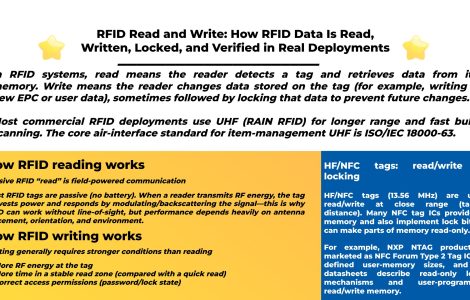 Knowledge
In RFID systems, read means the reader detects a tag and retrieves data from its memory. Write means the reader changes data stored on the tag (for example, writing a new EPC or user data), sometimes followed by locking that data to prevent future changes. Most commercial RFID deployments use UHF (RAIN RFID) for longer range and fast bulk scanning. The core air-interface […]
READ MOREIf you are interested in our services or need customized solutions, please feel free to contact us.