
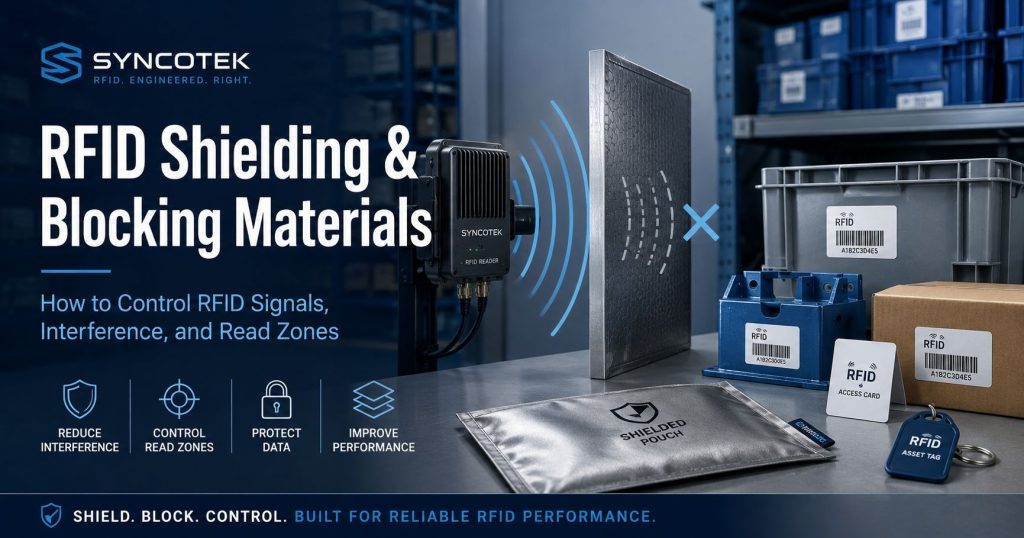
RFID systems are designed to communicate wirelessly, which is exactly what makes them powerful in asset tracking, inventory management, logistics, access control, and identification workflows. But that same wireless behavior can also create problems. In some situations, you want RFID signals to move freely and read tags quickly. In others, you need to prevent unauthorized reads, reduce interference, isolate a test area, or keep a reader from picking up tags outside the intended zone. That is where RFID shielding and blocking materials become important.
At a practical level, RFID shielding is not just a consumer “RFID wallet” topic. It is also an engineering and deployment topic. In industrial projects, shielding can help define read zones, reduce reader-to-reader crosstalk, isolate test setups, and improve reliability in dense RF environments. In consumer products, blocking materials are more often used to stop or reduce unwanted scans of cards, passports, or tagged items. These are related ideas, but they are not exactly the same design problem.
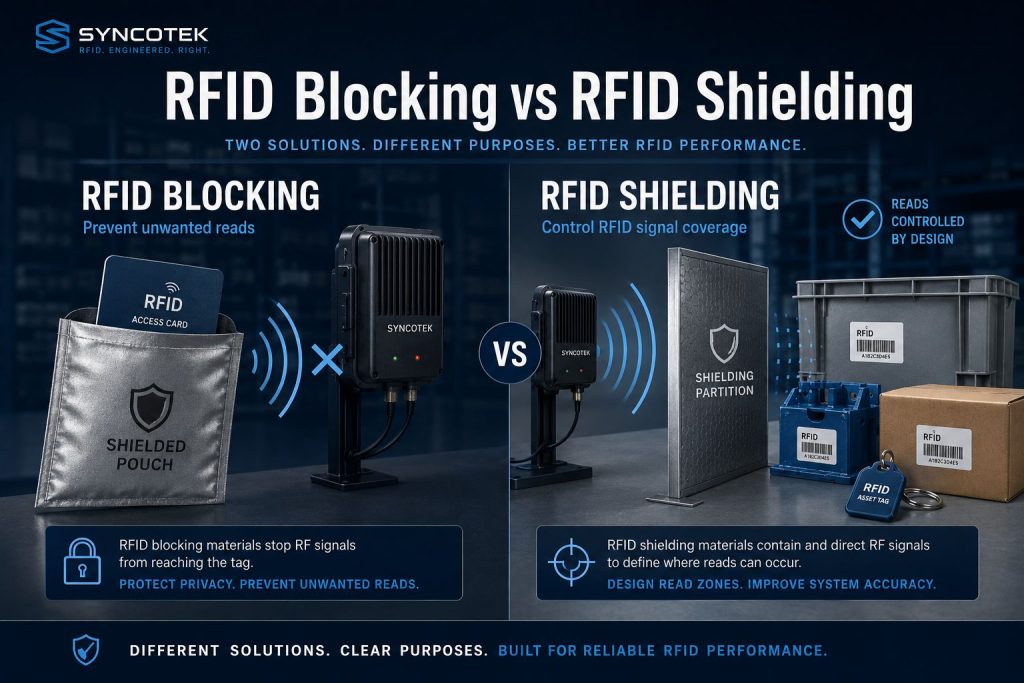
RFID shielding refers to the use of materials or structures that attenuate, contain, redirect, or block radio frequency signals so that readers and tags cannot communicate normally across that barrier.
That definition covers two common goals. The first is blocking unauthorized or unwanted reads, such as protecting a card, badge, or tag from being scanned when it should remain unreadable. The second is controlling system behavior, such as limiting stray reads at portals, separating nearby readers, or isolating tagged items during testing. NIST explicitly notes that shielding can limit the ability of eavesdroppers or unauthorized readers to collect data from an RFID system, but it also warns that shielding can hinder legitimate transactions when objects must be removed from shielded containers before they can be read.
The most familiar use of RFID blocking materials is privacy protection. A shielded sleeve, pouch, wallet layer, or enclosure can stop a reader from energizing a tag normally, which helps reduce the risk of unwanted reads.
In real RFID deployments, shielding is often less about privacy and more about read-zone control. A straightforward example: at a checkout area or read point, you want the reader to capture only the intended items, not nearby tagged objects on adjacent shelves or stations.
RFID systems can suffer from signal overlap, crosstalk, and interference from nearby electronics or adjacent readers. Shielding can isolate the RFID system from external RF noise and improve read reliability by creating more controlled operating zones. In healthcare, the FDA also notes that electromagnetic interference is a concern for electronic systems and devices in RF environments, which is one reason EMC-aware system design matters when RFID is deployed near sensitive equipment.
Shielded boxes, enclosures, and chambers are also used when teams need to test tags, readers, or encoded items in a controlled environment. NIST discusses grounded metal fencing and shielding as a valid control in RFID environments where RF containment is needed, and the source article points to Faraday cages and shielded test spaces as common solutions for labs and testing workflows.
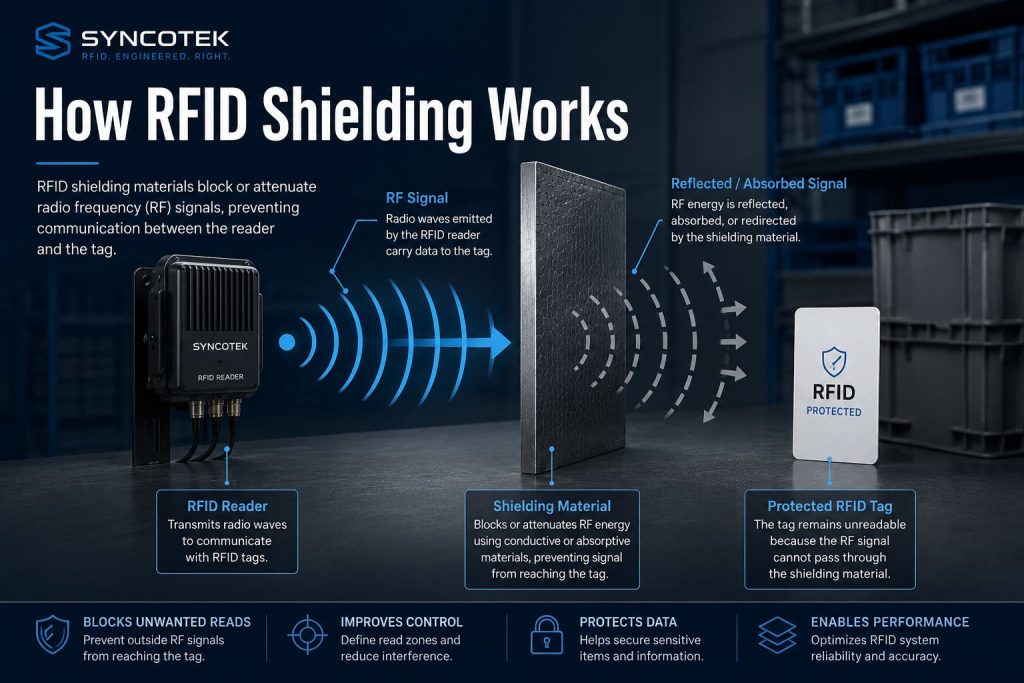
At a basic level, shielding works by interfering with the electromagnetic link between the reader and the tag. Modus, in its RF shielding guide, similarly explains that conductive materials reflect or redirect RF signals, while magnetic materials can redirect magnetic field components.
In practice, effectiveness depends on more than just “using metal.” Material conductivity matters, but so do magnetic properties, thickness, geometry, continuity, seams, openings, and the target frequency band. Modus emphasizes that even with good materials, openings and poorly sealed joints can compromise shield performance. Its guide also notes that material choice should match the frequency range, because low-frequency and high-frequency shielding behavior are not identical.
That is why a loosely wrapped piece of foil, a poorly sealed pouch, or a metal enclosure with unaddressed gaps may perform very differently from a well-designed shielded enclosure. NIST’s discussion of shielding as a control also makes clear that shielding is situational: it can help, but it can also block legitimate reads if applied without thinking through the workflow.
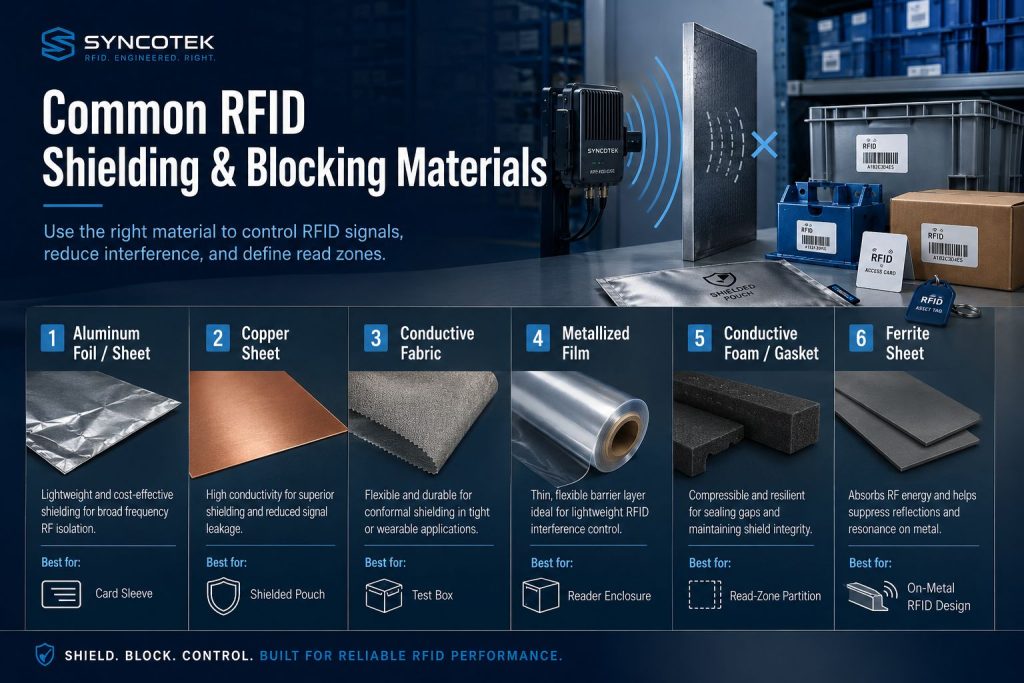
Metal foils and sheets are the most familiar shielding materials because metals are conductive and can attenuate RF energy effectively. Aluminum foil, copper sheets, and steel as common materials, while Modus identifies copper, aluminum, and steel as core RF shielding enclosure materials. Copper is highlighted there for superior conductivity and RF attenuation, aluminum for lower weight and cost, and steel for durability plus useful ferromagnetic behavior.
For RFID projects, aluminum is often seen as the simplest low-cost blocking material, but copper and engineered metal enclosures are usually better choices when repeatable performance matters. Steel can be useful where structural strength is important, but it should not automatically be treated as the best all-purpose shielding material. Material choice depends on the target band, the enclosure design, and the physical environment.
Conductive fabrics are useful when flexibility matters. The RFID4U describes conductive textiles made with metallic fibers or coatings and notes their use in portable shielding products such as bags, pouches, and wearable items. These materials are lighter and more flexible than rigid metal enclosures, which is why they are common in consumer RFID-blocking products and soft protective storage.
The tradeoff is that flexible shielding products depend heavily on construction quality. In real use, fabric continuity, overlapping seams, opening design, and wear resistance all matter. In other words, “conductive fabric” is not a guarantee by itself. A well-designed shielded pouch can work well; a thin, poorly constructed textile layer may not perform consistently enough for demanding technical use. The general RF-shielding principle from Modus still applies here: material alone is not enough without proper design and continuity.
Metallized films and laminates combine lightweight plastic structures with thin conductive layers. RFID4U lists these as a balance between flexibility and shielding, with typical applications such as card sleeves, secure packaging, and anti-theft or protective packaging solutions. They are especially relevant when the product needs a clean, thin construction rather than a rigid metal part.
These materials are often appropriate for disposable or semi-durable blocking products, but they should not be confused with robust industrial shielding solutions. Their usefulness depends on how complete the conductive layer is, how the seams are formed, and how well the package maintains coverage during normal handling.
Modus explains that RF shielding gaskets maintain electromagnetic continuity where enclosure sections meet and warns that even small gaps can compromise the entire shield. It highlights conductive elastomers filled with metal particles as common gasket materials, along with conductive foams and fabrics for lighter-duty needs.
For RFID engineers, this is an important point: a shielded cabinet, box, or reader zone is not only about wall material. Doors, seams, access panels, cable entries, and removable covers are often the weak points. If the enclosure has to open or serviceability is required, gasket design becomes part of shielding effectiveness, not just a mechanical detail.
Carbon-loaded plastics as a moderate shielding option for enclosures and housings. These materials can be useful when some structural integrity and lighter weight are desired, but they are generally not positioned as the highest-performance shielding solution. The advantage is easier integration into molded parts or product housings; the tradeoff is lower shielding strength than well-executed metal solutions.
For many RFID projects, carbon-loaded plastics are more relevant when designers need a housing that provides some attenuation while also meeting mechanical or manufacturing requirements. They are not usually the first choice when the goal is maximum isolation.
When full isolation is required, a properly designed conductive enclosure is the most direct approach. Faraday cages and conductive enclosures for labs, secure storage, and testing environments, while NIST uses grounded metal shielding as a concrete RFID security control. These solutions are common when organizations need to prevent reads into or out of a defined space.
But complete shielding has a cost in workflow convenience. NIST explicitly notes that shielded containers can prevent organizations from enjoying one of RFID’s core benefits—remote reading without extra handling—because the tagged objects may need to be removed from the shielded area for valid reads to occur. That is why Faraday-style isolation is powerful, but it is usually reserved for testing, security, transport, or narrow operational cases rather than everyday high-throughput reading.
Ferrite deserves special attention because it solves a different problem from simple privacy blocking. In HF/NFC and metal-adjacent RFID use cases, ferrite is often used to isolate the antenna’s magnetic field from nearby metal rather than to stop all communication outright. NXP’s antenna design guidance says ferrite shielding is beneficial when metal is close to the antenna because nearby metal generates eddy currents that absorb power and detune the antenna, and it states that ferrite is necessary for proper operation in close metallic environments. Avery Dennison makes a similar point for on-metal NFC tags, explaining that a ferrite layer isolates the magnetic field from the metal surface, redirects the inductive field, and prevents energy from being wasted as heat in the metal. TDK also states that its magnetic sheet products are effective when mounted on a reader/writer or tag in 13.56 MHz RFID systems.
This is an important distinction for readers of Syncotek content: sometimes the right “shielding material” is not used to make the tag unreadable. Sometimes it is used to make the tag or reader work correctly near metal by controlling field behavior. That is a different engineering objective from consumer RFID blocking, and confusing the two can lead to poor product selection.
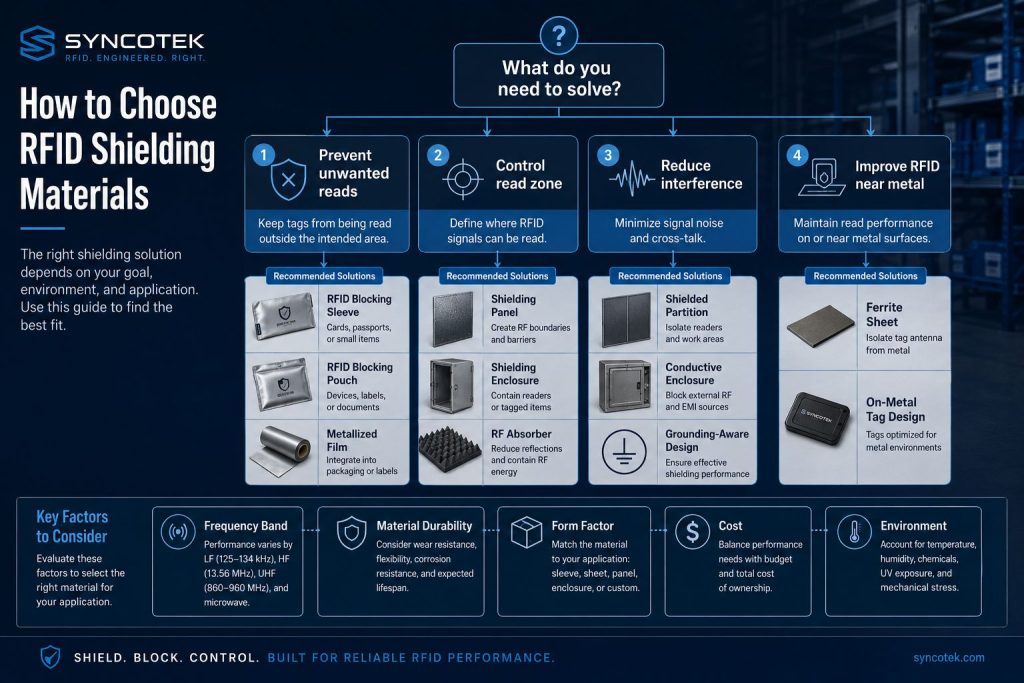
Shielding performance is frequency-dependent. Modus notes that low-frequency applications often favor steel or other ferromagnetic materials, while higher-frequency applications often rely more heavily on conductive materials such as copper and aluminum. The source article also emphasizes checking compatibility with the RFID frequency in use before choosing a material.
This is the most important selection question. Do you want to stop reads completely, contain them to a defined area, or improve tag performance near metal? A wallet sleeve, a shielded portal partition, and a ferrite-backed on-metal label do not solve the same problem, even though all may be described loosely as “shielding.”
A rigid metal box may be excellent for secure isolation but impractical for daily use. A conductive textile may be ideal for a pouch or wearable product but less reliable in a harsh industrial setting.
A shielding solution is only as strong as its weak points. Modus highlights the role of gaskets, compression, and enclosure continuity, and that point applies directly to RFID blocking products, shielded cabinets, and test boxes. An enclosure with an unsealed opening or poor compression around the door can leak RF energy even when the wall material itself is excellent.
Evaluating durability, mechanical strength, flexibility, weight, and cost. Modus adds environmental conditions and galvanic compatibility to that list, which matters for engineered products that combine multiple metals or must survive humidity and long-term field use. In other words, a material that looks good in a lab prototype may not remain the right choice outdoors, in washdown areas, or in long-life installed equipment.
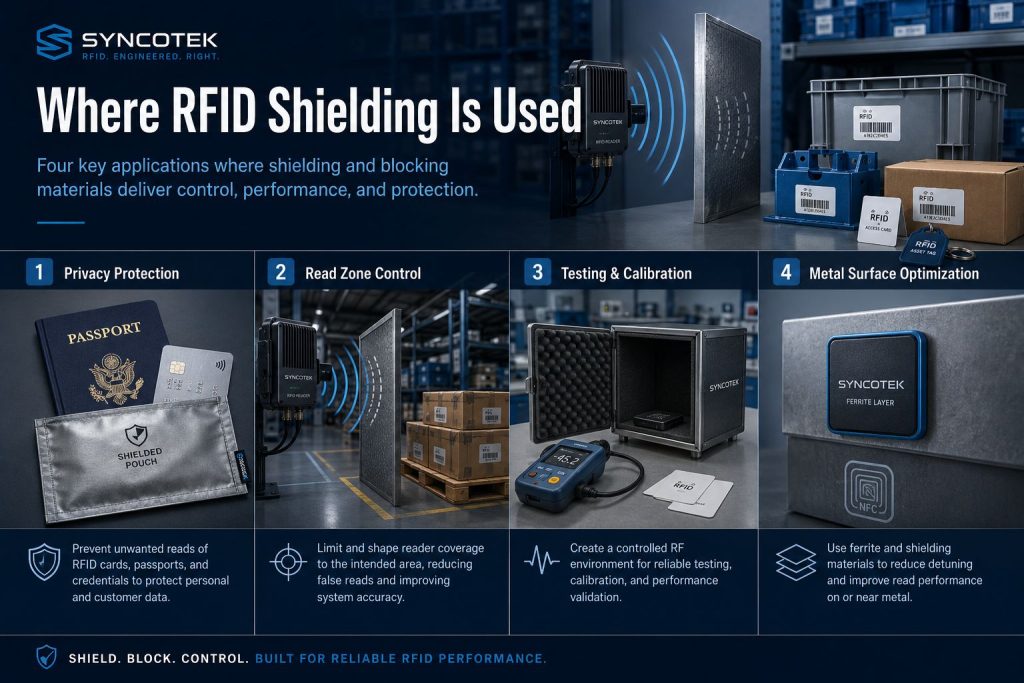
RFID shielding materials show up in more places than many buyers expect. Consumer examples include sleeves, wallets, pouches, and protective packaging made from conductive fabric, foil-based laminates, or metallized films. Industrial examples include shielded cabinets, tunnel areas, portal partitions, secure storage, and lab enclosures used for testing or workflow isolation. NIST’s portal-partition example and RFID4U’s descriptions of warehouses, labs, and secure zones make that practical range very clear.
In metal-adjacent HF/NFC use cases, ferrite-backed materials and related magnetic sheets are also part of the conversation, especially where antennas must operate near metal surfaces rather than be blocked from reading altogether. Avery Dennison, NXP, and TDK all treat these materials as performance-enabling layers in metal environments.
One common mistake is assuming that any metal layer automatically solves the problem. In reality, performance depends on material type, target frequency, enclosure quality, and whether gaps are controlled. Modus and NIST both make it clear that shielding is design-dependent, not simply material-dependent.
Another mistake is choosing a blocking solution when the real need is field control or on-metal optimization. For example, ferrite in an NFC on-metal tag is not there to make the tag unreadable; it is there to reduce metal-induced detuning and preserve usable field behavior. Avery Dennison and NXP both state this directly.
A third mistake is over-shielding the workflow. NIST specifically warns that shielding can interfere with valid RFID transactions. In other words, shielding is helpful only when it is aligned with the process design. Blocking too much can be as harmful as blocking too little.
RFID shielding and blocking materials are not one-size-fits-all products. They are tools for shaping RF behavior. Sometimes the goal is privacy and unauthorized-read prevention. Sometimes it is read-zone control, interference reduction, or test isolation. And in metal environments—especially for HF/NFC and certain tag designs—the right material may be a ferrite or magnetic sheet used to improve performance rather than block it. The strongest current sources on this topic all point to the same conclusion: good RFID shielding starts with a clear definition of the problem you are trying to solve, then matches material, frequency, form factor, and enclosure design to that need.
It can attenuate RFID signals and may reduce or stop reads in some cases, which is why it appears in many simple blocking examples. But engineered shielding is more reliable than improvised foil because performance also depends on coverage, continuity, openings, and the target frequency.
In everyday language they are often used interchangeably. In practice, “blocking” usually refers to stopping unwanted reads, while “shielding” can also mean controlling RF behavior in a system, such as defining read zones, reducing crosstalk, or isolating test areas.
Common options include aluminum, copper, steel, conductive fabrics, metallized films, conductive foams and gaskets, carbon-loaded plastics, and complete conductive enclosures. In some HF/NFC and on-metal designs, ferrite-based materials are also used.
Yes. Faraday-style enclosures and grounded metal shielding are used for secure isolation, testing, and controlled RFID environments. But they can also hinder legitimate reads and may require extra handling.
Because nearby metal can create eddy currents, absorb power, and detune the antenna. Ferrite can isolate the magnetic field from the metal surface and help the reader-tag interaction work more reliably.
The key factors are frequency band, the actual objective, enclosure continuity, form factor, environment, and durability. The “best” material depends on whether you need privacy blocking, industrial RF isolation, or metal-environment optimization.
Need a more suitable RFID setup for controlled read zones, metal assets, or industrial identification? Syncotek can help you evaluate RFID readers, tags, antennas, and deployment choices based on your application, environment, and read-control needs.
 Knowledge
The RFID system auto-identifies vehicles' weight, calculates net weight, and provides real-time monitoring for optimized efficiency.
READ MORE Uncategorized
RFID printers play an important role in RFID deployment because they combine two tasks in one workflow: printing visible information on a label and encoding digital data into the RFID inlay inside the label. For many businesses, RFID printing is the bridge between traditional barcode labeling and automated RFID identification. A properly selected RFID printer […]
READ MORE Knowledge
The RFID system auto-identifies vehicles' weight, calculates net weight, and provides real-time monitoring for optimized efficiency.
READ MORE Knowledge
What is an RFID chip? An RFID chip is a small integrated circuit (IC) used in radio-frequency identification systems to store an identifier and/or data and communicate wirelessly with an RFID reader. In everyday conversations, “RFID chip” can mean two different things: RFID tag chip (Tag IC / transponder IC) – the chip inside a […]
READ MORE Knowledge
Large events require thousands of physical interactions to happen accurately and quickly. Attendees must receive valid credentials, enter through the correct gates, access the areas included in their ticket, attend sessions, purchase food or merchandise, interact with sponsors, and leave the venue safely. At the same time, organizers need visibility into: ticket validation attendee arrival […]
READ MOREIf you are interested in our services or need customized solutions, please feel free to contact us.