
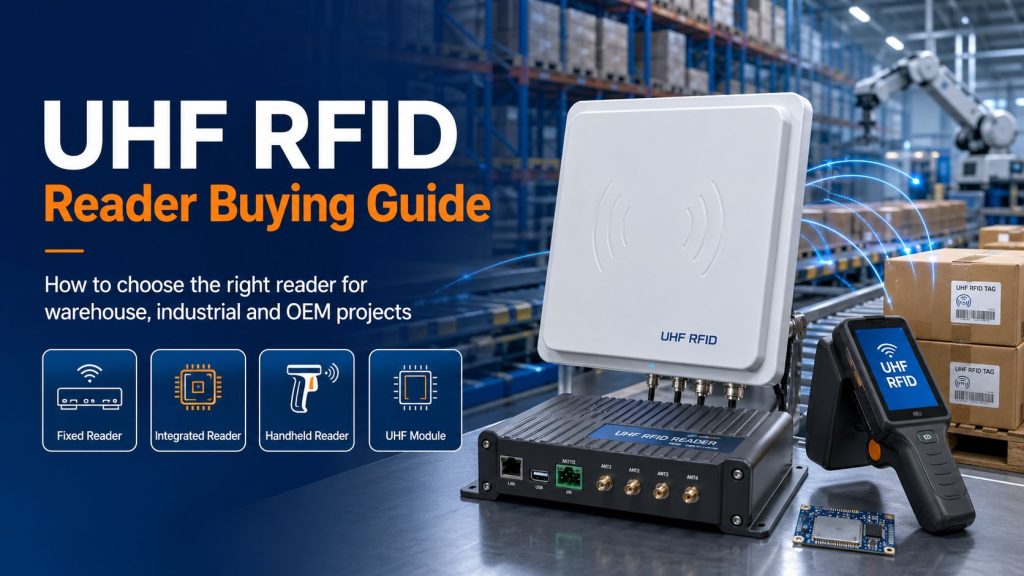
Choosing the right UHF RFID reader is one of the most important decisions in an RFID project. The reader determines how far tags can be detected, how many tags can be inventoried, how stable the system will be in real environments, and how easily RFID data can be connected to your software, kiosk, warehouse system, production line, or access control platform.
For buyers, system integrators and OEM engineers, the challenge is not simply “which reader has the longest range.” A reliable UHF RFID system depends on the reader type, RF output power, antenna design, regional frequency, tag selection, software interface, installation environment and project workflow.
This complete buying guide explains how UHF RFID readers work, what types are available, which specifications matter most, and how to choose the right reader for warehouse inventory, logistics, manufacturing, retail, asset tracking, parking, libraries, smart cabinets and embedded OEM devices.
A UHF RFID reader is a device that communicates with UHF RFID tags using radio-frequency signals. In most commercial and industrial applications, UHF RFID belongs to the RAIN RFID ecosystem. RAIN RFID systems are based on readers and tags implementing the ISO/IEC 18000-63 air-interface protocol, also known as GS1 UHF Gen2.
Unlike barcode scanning, UHF RFID does not require direct line of sight. A reader can identify one or many tags through radio waves, which makes it useful for inventory counting, item tracking, access control, logistics automation and production management.
A complete UHF RFID system usually includes:
| Component | Function |
|---|---|
| UHF RFID reader | Sends RF signals and receives tag responses |
| UHF RFID antenna | Creates the reading zone and controls signal direction |
| UHF RFID tags | Store EPC, TID or user data attached to items |
| Cables and accessories | Connect reader and antenna in fixed systems |
| Software / middleware | Filters raw reads and sends useful data to business systems |
| Host system | ERP, WMS, MES, POS, access control or custom application |
Syncotek’s RFID portfolio includes UHF modules, integrated readers, fixed readers, desktop readers, access gates, handheld readers, intelligent RFID devices, antennas, tags, active RFID products and RFID printers, making it possible to match hardware to different project architectures.
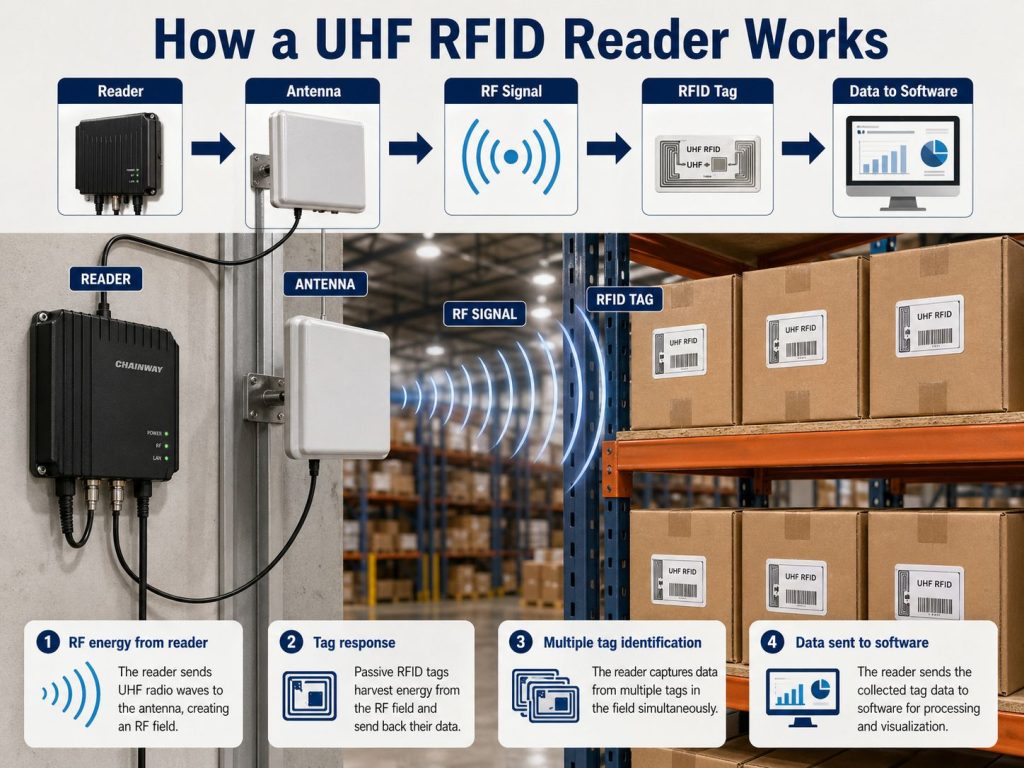
A UHF RFID reader emits RF energy through an antenna. When a passive UHF RFID tag enters the reading zone, the tag receives energy from the reader signal and responds by backscattering information to the reader.
The basic process is:
In real projects, the reading result is affected by many factors:
This is why a UHF RFID reader should not be selected by range alone. The correct reader must match the full project environment.
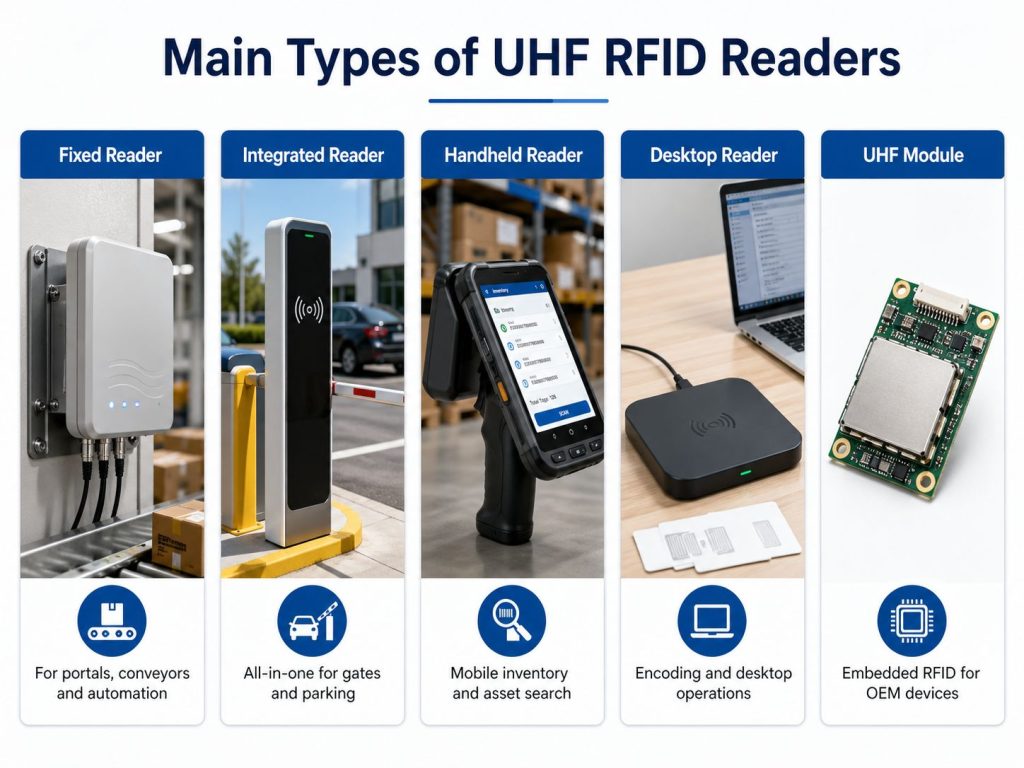
There are several types of UHF RFID readers. Each type is designed for a different installation style and workflow.
A UHF fixed RFID reader is usually installed in a fixed location and connected to one or more external antennas. It is widely used in warehouses, dock doors, production lines, conveyor systems, RFID tunnels, access gates and automated checkpoints.
Typical applications include:
A fixed reader is suitable when you need stable, continuous reading and flexible antenna layout.
A UHF integrated RFID reader combines the reader and antenna into one device. It is easier to install than a fixed reader with external antennas and is commonly used in parking, gates, access control, logistics lanes and vehicle identification.
Integrated readers are useful when the reading direction is clear and the installation does not require multiple external antennas.
A UHF handheld RFID reader is designed for mobile operations. It is usually used by warehouse staff, field technicians, retail workers, library operators or asset management teams.
Common applications include:
Handheld readers are ideal when people need to move through the environment and scan items from different directions.
A UHF desktop RFID reader is a compact reader used for short-range reading, tag encoding, label commissioning, access cards, front-desk operations or workbench testing.
It is suitable for:
A UHF RFID module is a compact embedded reader board used inside another device. It is not always sold as a finished reader, but it is one of the most important options for OEM customers.
Syncotek’s UHF module page lists EPC Gen2 / ISO 18000-63 support, FCC / ETSI bands, 27–33 dBm output options, 1–16 antenna port options and SDK support for OEM applications such as handheld terminals, printers, gate readers, industrial lines, kiosks and vehicle identification.
UHF RFID modules are often used in:
| Reader Type | Best For | Advantages | Limitations |
|---|---|---|---|
| Fixed RFID reader | Warehouses, portals, conveyors, production lines | Flexible antenna layout, stable performance, suitable for automation | Requires antenna and installation design |
| Integrated RFID reader | Gates, parking, vehicle ID, simple portals | Easy installation, compact structure | Less flexible than multi-antenna fixed readers |
| Handheld RFID reader | Inventory, asset search, mobile operation | Portable, flexible, user-friendly | Depends on operator workflow and battery life |
| Desktop RFID reader | Encoding, testing, front-desk work | Compact and easy to use | Shorter range and limited coverage |
| UHF RFID module | OEM devices and embedded systems | Small size, customizable, suitable for integration | Requires engineering development |
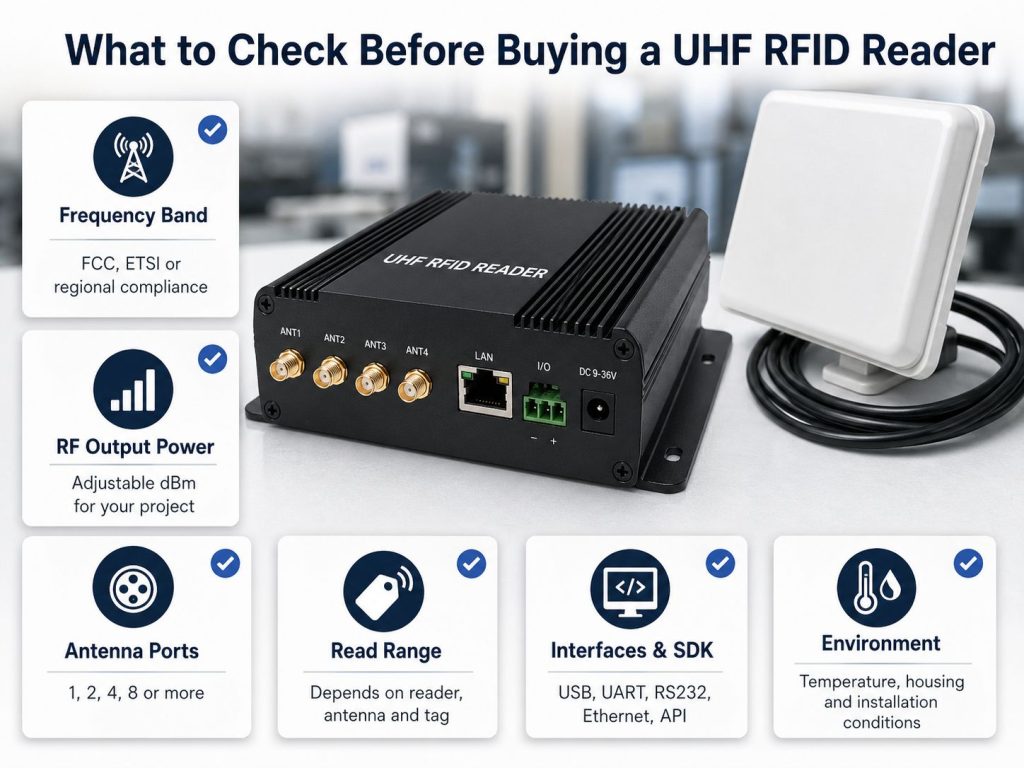
UHF RFID frequency requirements vary by region. For example, FCC Part 15.247 covers operation in the 902–928 MHz band and includes limits for frequency hopping systems and conducted output power.
In Europe, ETSI EN 302 208 covers RFID equipment operating in 865–868 MHz and 915–921 MHz bands, with power limits specified for these bands.
Before selecting a reader, confirm the target region:
| Region / Market | Common UHF RFID Band |
|---|---|
| North America | 902–928 MHz |
| Europe | 865–868 MHz, with upper-band rules in some markets |
| China | Commonly around 920–925 MHz depending on product configuration |
| Japan | Region-specific UHF RFID rules |
| Global projects | Multi-region reader configuration may be required |
For export projects, frequency configuration is not optional. A reader used in the wrong region may cause compliance problems and unstable performance.
RF output power is usually measured in dBm. Higher power can help improve read range, but it does not automatically solve every problem. Excessive power can create unwanted reads, interference or compliance issues.
Common reader power levels include:
| Power Level | Typical Use |
|---|---|
| 20–27 dBm | Short to medium-range applications |
| 27–30 dBm | General UHF RFID reading |
| 30–33 dBm | Long-range and industrial applications |
| Adjustable output | Recommended for real-world deployment tuning |
A good reader should support adjustable RF output power, because the best setting depends on the antenna, tag and environment.
Antenna ports determine how many antennas can be connected to one reader.
| Antenna Port Count | Typical Application |
|---|---|
| 1 port | Simple station, desktop, single direction |
| 2 ports | Small gate, two-side coverage |
| 4 ports | Dock doors, conveyor zones, warehouse portals |
| 8 ports | Complex portals, tunnels, multi-zone systems |
| 16 ports | Large RFID tunnels, industrial automation, multi-point systems |
More antenna ports do not always mean better performance. The correct number depends on how many read zones you need and how precisely you want to control direction.
Read range is one of the most searched terms, but it is also one of the most misunderstood. A “long range RFID reader” does not work alone. Read range is created by the combination of:
For example, a high-power reader with the wrong antenna or wrong tag may perform worse than a properly matched lower-power system.
In warehouse and logistics applications, the reader may need to identify many tags quickly. Important performance indicators include:
If your project involves moving cartons, pallets or garments, reading stability under motion is more important than a laboratory maximum range number.
A UHF RFID reader must connect to your host system. Common interfaces include:
| Interface | Common Use |
|---|---|
| USB | Desktop readers, testing, encoding |
| UART | Embedded modules |
| RS232 | Industrial machines and legacy systems |
| RS485 | Industrial long-distance communication |
| Ethernet | Fixed readers, warehouses, automation |
| Wi-Fi | Mobile or flexible installation |
| Bluetooth | Handheld readers and accessories |
| GPIO | Sensors, alarms, gates, triggers and lights |
| Wiegand | Access control integration |
For industrial projects, Ethernet, GPIO and RS232/RS485 are often important. For OEM projects, UART, USB and SDK support may be more important.
Hardware performance is only part of the project. You also need to consider how easily the reader can be integrated into your system.
Check whether the supplier can provide:
If your team needs to connect RFID data to ERP, WMS, MES or custom software, SDK quality can directly affect project speed.
For industrial use, check:
A reader used in a clean office is different from a reader used near forklifts, dock doors, metal racks, production equipment or outdoor parking lanes.
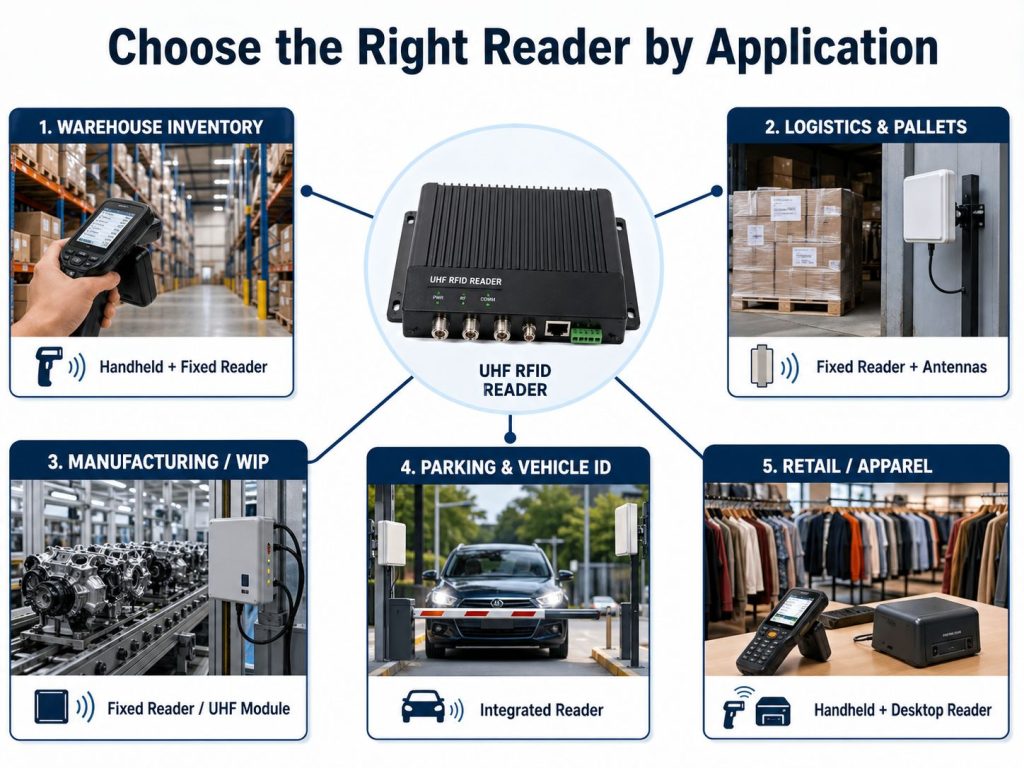
For warehouse inventory, the common reader options are fixed readers, handheld readers and RFID portals.
Recommended configuration:
| Need | Recommended Hardware |
|---|---|
| Mobile inventory counting | UHF handheld reader |
| Dock door verification | Fixed reader + multiple antennas |
| Pallet tracking | Fixed reader or integrated reader |
| Carton-level reading | Fixed reader + optimized antennas |
| Tag commissioning | Desktop reader |
A warehouse system often needs both fixed and handheld readers. Fixed readers automate key checkpoints, while handheld readers help with exception handling and cycle counting.
Logistics projects often require long reading distance, fast tag inventory and stable reading during movement.
Recommended reader features:
For pallet and dock-door applications, antenna placement is just as important as reader selection.
Manufacturing RFID projects often require readers installed near workstations, conveyors, machines or production lines.
Recommended features:
In WIP tracking, the goal is not always maximum range. In many cases, controlled read zones are more important than long-distance reading.
For parking, vehicle access and long-distance gate reading, integrated readers are often used because they are easy to install and have a focused reading direction.
Recommended features:
For windshield tags or vehicle tags, the tag type and mounting position should be tested before full deployment.
Retail and apparel applications require fast tag reading, high-volume inventory and good handheld usability.
Recommended hardware:
Retail RFID requires good software filtering because many tags may be close together.
Library RFID systems may use desktop readers, handheld readers, access gates and self-service devices.
Recommended features:
For smart cabinets, kiosks, printers and self-service machines, UHF RFID modules are often the best choice.
Recommended module features:
OEM customers should evaluate not only the module specification, but also the supplier’s engineering support and long-term availability.
Before requesting a quotation, prepare the following information:
| Question | Why It Matters |
|---|---|
| What items will be tagged? | Tag type and antenna design depend on material |
| What read range is required? | Determines reader power, antenna and tag selection |
| Is the item metal, liquid, paper, fabric or plastic? | Different materials require different tags |
| Is the reader fixed, handheld or embedded? | Determines reader form factor |
| How many tags must be read at once? | Affects anti-collision and software filtering |
| Is the item moving or stationary? | Affects antenna placement and read timing |
| Which country or region will the system operate in? | Determines frequency and compliance configuration |
| What software system must be connected? | Determines interface and SDK requirements |
| Is GPIO needed? | Important for sensors, gates, alarms and triggers |
| Is customization required? | Important for OEM and project-based deployments |
The more information you provide, the faster a manufacturer can recommend the correct reader, antenna and tag combination.
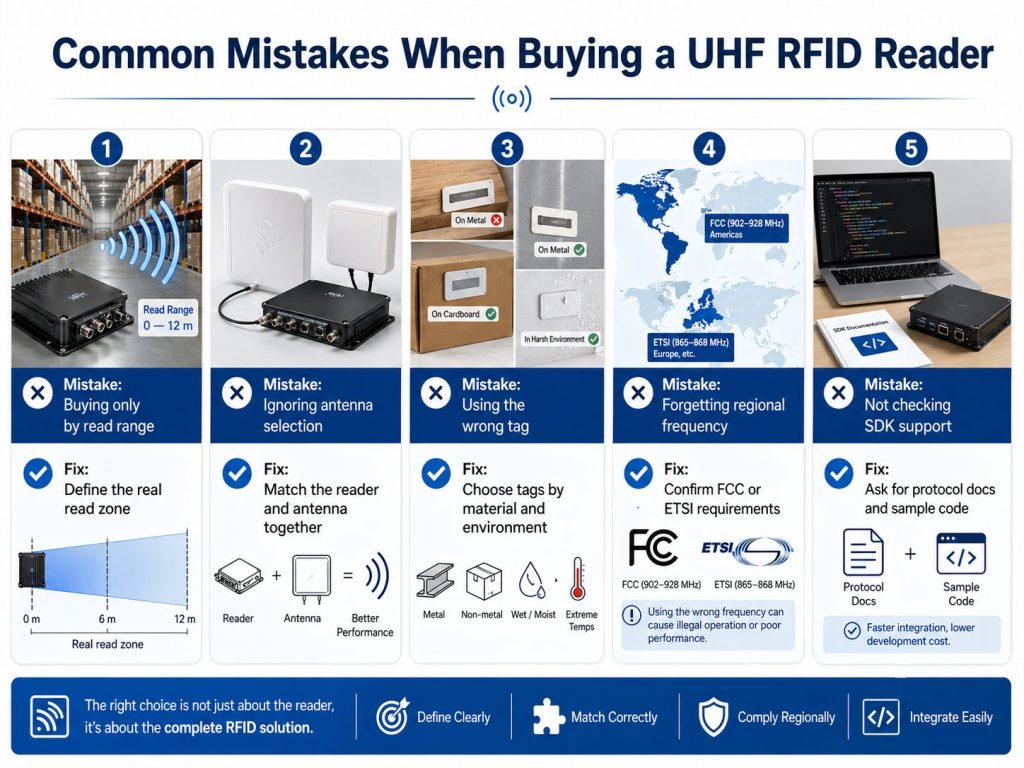
Maximum read range is usually measured under ideal conditions. Real environments are different. Metal racks, liquids, people, tag orientation and RF noise can all reduce performance.
Better approach: define the real read zone and test the complete system.
A fixed reader without the right antenna cannot deliver good results. Antenna gain, polarization, beamwidth and installation angle all matter.
Better approach: select the reader and antenna together.
Many RFID problems are actually tag problems. A general label may not work well on metal, liquid containers, tires, tools or high-temperature items.
Better approach: choose tags based on material and mounting environment.
A reader configured for one region may not be suitable for another market.
Better approach: confirm FCC, ETSI or other regional requirements before purchasing.
If your software team cannot easily communicate with the reader, the project may be delayed.
Better approach: request SDK, protocol documentation and sample code before bulk purchase.
A reader used in an office is not the same as a reader installed in a warehouse dock, factory floor or outdoor parking lane.
Better approach: consider temperature, humidity, housing, connectors and power protection.
A UHF RFID reader is usually a complete device with housing, power input, communication ports and finished interfaces. A UHF RFID module is an embedded board used inside another device.
| Item | UHF RFID Reader | UHF RFID Module |
|---|---|---|
| Form | Finished device | Embedded board |
| User | System integrator, warehouse, factory | OEM engineer, device manufacturer |
| Installation | External installation | Built into another product |
| Interfaces | Ethernet, RS232, RS485, USB, GPIO | UART, USB, TTL, board-level interface |
| Customization | Medium | High |
| Best for | RFID systems | RFID-enabled devices |
Choose a finished reader if you are building a complete RFID system. Choose a UHF RFID module if you are adding RFID capability to a kiosk, printer, smart cabinet, handheld terminal or custom device.
| Feature | Fixed Reader | Integrated Reader |
|---|---|---|
| Antenna | External antenna required | Built-in antenna |
| Installation flexibility | High | Medium |
| Best for | Multi-zone and complex systems | Simple directional reading |
| Typical applications | Warehouses, portals, conveyors, tunnels | Parking, gates, access control |
| Expansion | Supports multiple antennas | Usually limited by built-in design |
| Engineering requirement | Higher | Lower |
If your project needs multiple antennas, controlled zones or future expansion, choose a fixed reader. If your project needs a simple, compact, long-range reading point, choose an integrated reader.
| Feature | Handheld Reader | Fixed Reader |
|---|---|---|
| Operation | Manual mobile scanning | Automatic fixed reading |
| Best for | Inventory, search, field service | Portals, conveyors, dock doors |
| Flexibility | High | Depends on installation |
| Automation level | Medium | High |
| User involvement | Required | Minimal |
| Software integration | Mobile app / Android | WMS, MES, ERP, middleware |
In many real projects, both are used together. Fixed readers automate key checkpoints, while handheld readers handle inventory verification, exception search and manual operations.
A UHF RFID project is not only about the reader. It is about the matching of reader, antenna, tag, software and installation environment.
Working with an experienced RFID hardware manufacturer can help you:
For system integrators and OEM companies, this support can be more important than a small price difference between readers.
Syncotek provides UHF RFID modules, fixed readers, integrated readers, handheld readers, desktop readers, antennas and tags for OEM devices, warehouse inventory, logistics, manufacturing, access control, parking, libraries, retail and industrial automation.
If you are not sure which RFID reader to choose, share your application details with our team:
Our engineers can recommend a matched UHF RFID reader, antenna and tag solution for your project.
For warehouse inventory, the best option depends on the workflow. A handheld RFID reader is suitable for mobile cycle counting, while a fixed RFID reader with external antennas is better for dock doors, portals, conveyors and automated checkpoints.
UHF RFID read range can vary from short range to more than 10 meters in suitable conditions. The real range depends on reader power, antenna gain, tag type, tag orientation, material, frequency regulations and environment.
No. Higher power may increase range, but it can also create unwanted reads and interference. In many projects, controlled read zones are more important than maximum power.
Choose a fixed reader if you need multiple antennas, flexible read-zone design or industrial automation. Choose an integrated reader if you need a compact all-in-one solution for gates, parking or simple long-range reading.
Choose a UHF RFID module when you want to embed RFID capability into another device, such as a kiosk, printer, smart cabinet, handheld terminal, self-service machine or industrial controller.
For fixed systems, Ethernet, RS232, RS485 and GPIO are commonly used. For desktop readers, USB is common. For embedded modules, UART and USB are important. For handheld readers, Wi-Fi, Bluetooth and Android SDK support may be required.
Not always. UHF RFID frequency rules vary by region. You should confirm the target country or market before purchasing and configure the reader accordingly.
Common reasons include wrong tag type, poor tag placement, metal or liquid interference, incorrect antenna polarization, low reader power, excessive cable loss, software filtering problems or regional frequency mismatch.
Yes, in most projects. The reader collects tag data, but software is needed to filter duplicate reads, manage events, connect to ERP/WMS/MES systems and convert raw reads into useful business data.
You should provide your application, required read range, country, item material, tag type, number of tags, reader type, interface requirement, software platform, installation environment and estimated quantity.
 Knowledge
Tools are essential assets in many industries. Manufacturing plants, construction companies, hospitals, repair teams, rental businesses, warehouses, and maintenance departments all depend on tools being available, traceable, and properly maintained. However, tool management is often difficult. Tools may be misplaced, borrowed without record, left at job sites, stored in the wrong cabinet, sent for maintenance […]
READ MORE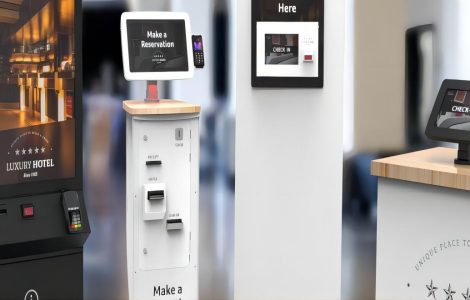 Case Show
Card dispensers for Hotel Self-Check-in Kiosk
READ MORE Knowledge
Businesses often know how many assets they purchased but have much less visibility into where those assets are, who is using them, whether they are available, when they were last inspected, or whether they still exist. The problem appears across many industries. A manufacturer may need to manage thousands of tools and fixtures. An IT […]
READ MORE Knowledge
Active RFID is a type of radio frequency identification technology that uses battery-powered tags to transmit data to RFID readers. Because the tag has its own power source, it can send signals over a much longer distance than a passive RFID tag, which relies on the reader’s signal for energy. That is why Active RFID is commonly […]
READ MORE Knowledge
RFID tags are electronic identifiers that allow physical products, assets, containers, tools, garments and other objects to communicate wirelessly with an RFID reader. Unlike a barcode, an RFID tag normally does not need to be directly visible to the reader. Depending on the RFID technology and system design, readers can identify individual tags, inventory multiple […]
READ MOREIf you are interested in our services or need customized solutions, please feel free to contact us.