
When people compare near-field vs far-field in RFID, they are really comparing two different ways energy and data move between the reader and the tag. In RFID, near-field systems are based on magnetic coupling and are typically associated with LF and HF/NFC, while far-field systems are based on radiated electromagnetic waves and backscatter and are typically associated with UHF RFID. That difference affects range, tag behavior, antenna design, and use case.
For most buyers, this is not just a theory question. It explains why some RFID systems are designed for a very short, controlled read zone, while others are built for meters of range and fast bulk reading. Syncotek’s own RFID knowledge pages make this distinction clearly: LF and HF use near-field inductive coupling, while UHF generally uses far-field backscatter.
Related Read: https://syncotek.com/lf-vs-hf-vs-uhf-rfid/
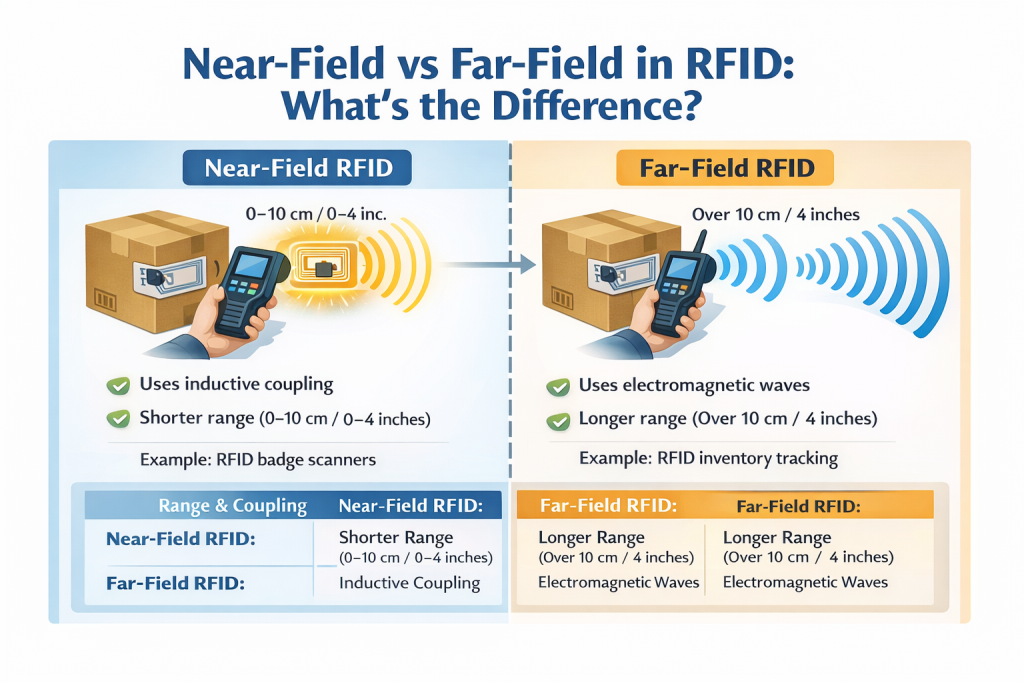
In RFID, near-field refers to communication based mainly on the magnetic field close to the reader antenna. The reader uses a coil to create a magnetic field, and a nearby tag with its own coil couples to that field, harvests energy, and responds by load modulation. This is why near-field RFID is often described as working more like a transformer than a long-range radio link.
Near-field RFID is mainly used by:
In practice, near-field reads are usually very short range. Syncotek’s near-field coupling guide says usable range is usually centimeters, sometimes extending to tens of centimeters for HF with larger coils and optimized tags. Impinj also notes that near-field RAIN RFID applications are generally less than 30 cm.
In RFID, far-field refers to communication that relies on radiated RF energy rather than close magnetic coupling. The reader transmits RF energy outward, the passive tag harvests enough of that energy to power up, and then the tag replies by backscattering or modulating the reflected signal back to the reader.
Far-field RFID is typically associated with:
Impinj states that far-field applications can extend to several tens of meters, depending on setup and environment. Atlas RFID also notes that far-field antennas can read from a few centimeters to more than 30 feet in ideal conditions.
The easiest way to understand it is this:
Near-field communication depends on magnetic-field coupling very close to the antenna, and that coupling drops off quickly with distance. RFID4U explains that inductive coupling is strong only close to the antenna and weakens rapidly as distance increases. Far-field systems, by contrast, rely on propagating radio waves, so they are much better suited for longer-distance reads.
That is why near-field RFID is commonly used for tap, close-range verification, access cards, NFC interactions, and tightly controlled read zones, while far-field RFID is used for inventory counting, dock doors, warehouse portals, and bulk item tracking.
A practical summary is:
LF and HF RFID use inductive coupling. The reader coil creates a magnetic field, the tag coil captures energy, and the tag responds by changing its electrical load so the reader can detect it.
UHF RFID generally uses backscatter. The reader sends RF energy, the passive tag powers up, and the tag reflects/modulates the signal back. This enables longer range and fast bulk reading.
There is one important nuance: special near-field UHF antennas do exist for controlled short-range applications. So the near-field/far-field distinction is mainly about coupling method and antenna behavior, not only the frequency label. Syncotek explicitly notes that UHF generally uses far-field backscatter, though near-field UHF antennas exist for special short-range control.
Near-field RFID is strong when you want a small, predictable read zone. Because the interaction is short range, it can reduce stray reads and make the user action more intentional. Syncotek describes this as a controlled “tap/close” style of reading. Impinj also notes that near-field readability is less affected by nearby dielectrics such as water or metal in short-range applications.
Typical near-field strengths include:
The tradeoff is range. Near-field systems are naturally short-range, so they are not ideal for reading items across a room, through a dock door, or in a bulk inventory zone.
Far-field RFID is better when you need distance and throughput. It is the standard choice for many UHF deployments because it supports meters of range, bulk reading, and faster automation in logistics and warehousing.
Typical far-field strengths include:
Because the read zone is larger, stray reads can become a problem if antenna placement and zone design are not handled carefully. Atlas RFID specifically notes that unintended tag reads are a common issue in far-field deployments because of the wider read zone. Impinj also notes that dielectrics can weaken communication in far-field applications.
Near-field RFID is commonly used for:
Far-field RFID is commonly used for:
The right choice depends on what you are trying to achieve.
Choose near-field when you need:
Choose far-field when you need:
A good practical rule is: if the question is “Which tag is directly in front of me right now?” near-field is often better. If the question is “Which items are moving through this zone or sitting in this area?” far-field is usually the better fit. This is an inference from how these systems are described and deployed across RFID references.
Near-field and far-field RFID are not just two antenna labels. They represent two different physical communication methods. Near-field RFID uses magnetic inductive coupling and is best for short, controlled reads. Far-field RFID uses radiated RF and backscatter and is best for longer-range, bulk-reading applications. Once that difference is clear, it becomes much easier to choose the right RFID system for a real project.
 Knowledge
RFID is often grouped into three main frequency families: LF (Low Frequency), HF (High Frequency), and UHF (Ultra-High Frequency). Picking the right band is one of the biggest decisions in any RFID project because it affects read range, speed, tag cost, phone compatibility, performance near metal/liquids, and system architecture. This guide compares LF vs HF vs UHF in a practical way […]
READ MORE Knowledge
What is backscatter (in RFID)? Backscatter is the communication method used by most passive UHF RFID tags to send data back to a reader without generating their own RF carrier. Instead of transmitting like a radio, the tag changes its electrical load/impedance, which changes how much of the reader’s RF signal is reflected back. ISO’s UHF air-interface standard explicitly describes this as a passive-backscatter RFID […]
READ MORE Knowledge
RFID tags are electronic identifiers that allow physical products, assets, containers, tools, garments and other objects to communicate wirelessly with an RFID reader. Unlike a barcode, an RFID tag normally does not need to be directly visible to the reader. Depending on the RFID technology and system design, readers can identify individual tags, inventory multiple […]
READ MORE Knowledge
What is RFID software? RFID software is the layer that turns RFID hardware signals (readers, antennas, tags, sensors) into usable data and workflows—inventory updates, asset movements, shipping/receiving events, access logs, and analytics. In most real deployments, RFID systems require middleware: software that sits between RFID interrogators (readers) and enterprise applications (WMS/ERP/MES/POS). It manages/configures devices and processes raw tag data by filtering duplicates […]
READ MORE Knowledge
Inventory management is one of the most important parts of modern business operations. Whether a company manages raw materials, finished goods, returnable containers, tools, retail products, medical supplies, or industrial assets, inventory accuracy directly affects cost, delivery speed, productivity, and customer satisfaction. Traditional inventory methods often rely on manual counting, spreadsheets, or barcode scanning. These […]
READ MOREIf you are interested in our services or need customized solutions, please feel free to contact us.