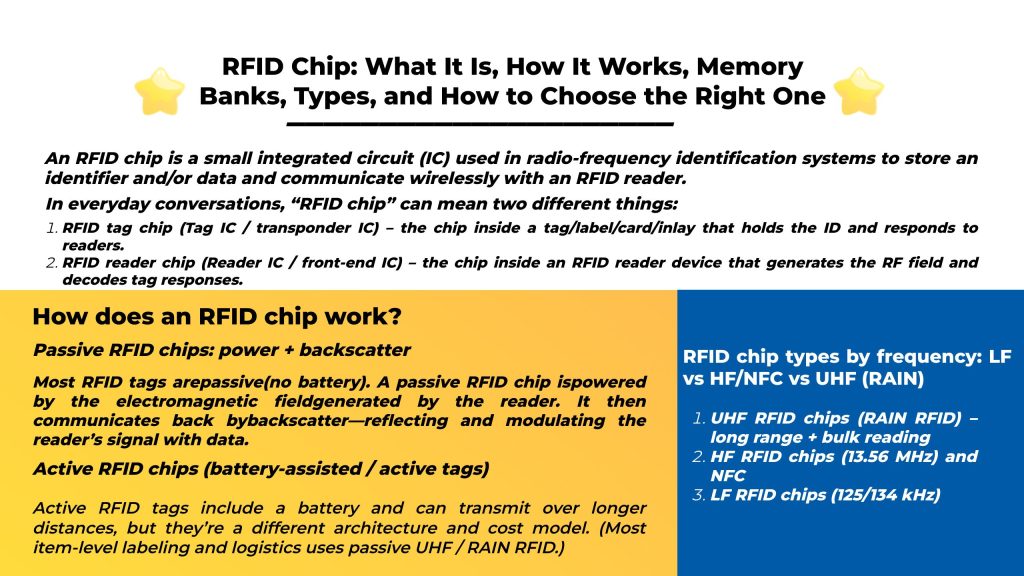
An RFID chip is a small integrated circuit (IC) used in radio-frequency identification systems to store an identifier and/or data and communicate wirelessly with an RFID reader.
In everyday conversations, “RFID chip” can mean two different things:
Most people searching “rfid chip” are talking about the tag chip (the one embedded in a label, card, or hard tag). RFID systems typically consist of a tag (transponder) and a reader.
An RFID chip alone is not a “tag” you can read at distance—because a tag also needs an antenna (and packaging).
|Term|What it is|What it includes|Typical form|
|||||
|RFID chip (Tag IC)|The silicon IC that stores ID/data and handles RF communication|IC only|Tiny die/packaged IC|
|RFID inlay|The “core” of an RFID label/tag|Antenna + chip on substrate (often PET)|Dry inlay / wet inlay|
|RFID tag/label/card|Finished product applied to items|Inlay + face stock/adhesive/encapsulation|Label, card, hard tag|
Many industry explainers describe an inlay as a combination of antenna + microchip, layered into a label structure.
Most RFID tags are passive (no battery). A passive RFID chip is powered by the electromagnetic field generated by the reader. It then communicates back by backscatter—reflecting and modulating the reader’s signal with data.
That’s why RFID can identify objects without line-of-sight and why range and reliability depend heavily on antenna design, environment, and regulatory power limits.
Active RFID tags include a battery and can transmit over longer distances, but they’re a different architecture and cost model. (Most item-level labeling and logistics uses passive UHF / RAIN RFID.)
Realted Read: Passive RFID vs Active RFID: Differences, Pros/Cons, Use Cases & How to Choose
RFID “chip selection” starts with the frequency family you’re building around:
For UHF EPC Gen2 / ISO 18000-63 tags, the chip commonly exposes four memory banks:
Many practical guides explain EPC/User as programmable, and TID as chip-identification-focused and not user-updatable.
A proven best practice in supply chain is:
When people say “RFID chip,” they often really need an inlay decision (because performance is mainly about the antenna + packaging):
Avery Dennison also notes a common rule of thumb: larger inlays generally mean larger antennas and better RF performance—but size must match your item and read zone design.
When evaluating tag chips (especially UHF), these are the specs that matter most:
Better sensitivity can improve read range and reliability—especially for small labels or challenging items.
Some chips support advanced features (passwords, privacy modes, authentication primitives). Selection depends on whether you need anti-counterfeiting, brand protection, or controlled write access.
Chip families often target different needs: fast encoding, higher sensitivity, special form factors, or enhanced security. (For example, NXP’s UCODE line is positioned for supply chain and item-level use cases with speed/sensitivity/security considerations.)
Even with the same tag IC, performance can vary drastically due to:
Many label manufacturers emphasize specialized label constructions for difficult substrates (metal, glass, harsh temperature).
Instead of starting with “Which RFID chip is best?”, start with the use case:
RFID success is measured in system performance, not chip datasheets alone:
Most UHF tags store a relatively small amount of data in EPC/User memory; the standard memory bank structure is defined in Gen2/ISO 18000-63 ecosystems.
For larger data, store a unique ID on the tag and keep details in your database.
Not for practical RFID tagging. The “tag” needs an antenna to harvest power and communicate.
They’re related but usually refer to different frequency families and standards. NFC is generally based on HF (13.56 MHz) and contactless standards like ISO/IEC 14443, while UHF RAIN RFID uses ISO/IEC 18000-63 in the 860–960 MHz band.
Environment and system design: antenna placement, metal/liquid nearby, orientation, and reader configuration can dominate results—sometimes more than the chip model itself.
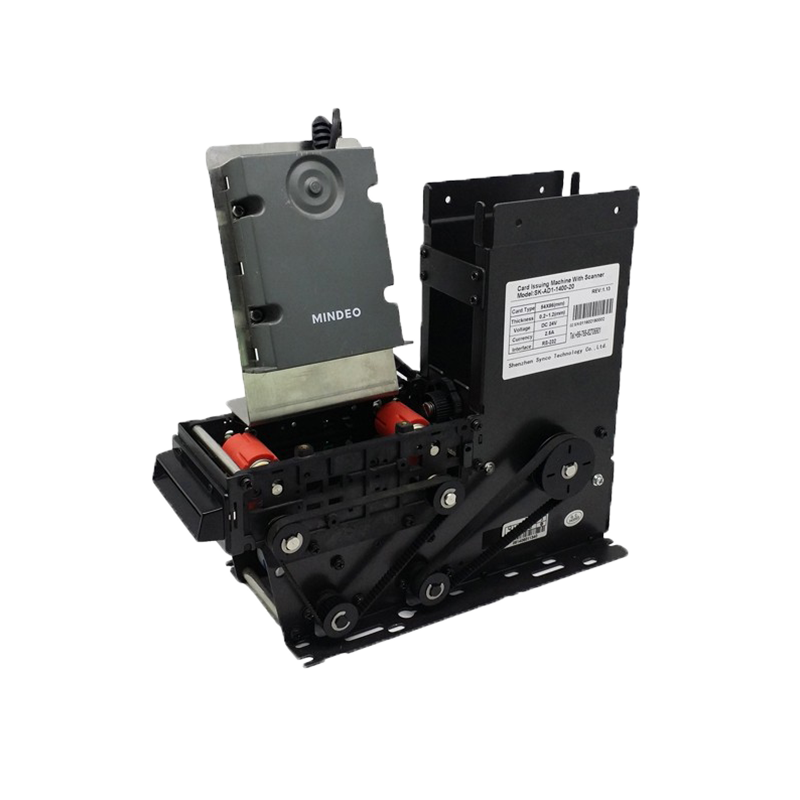
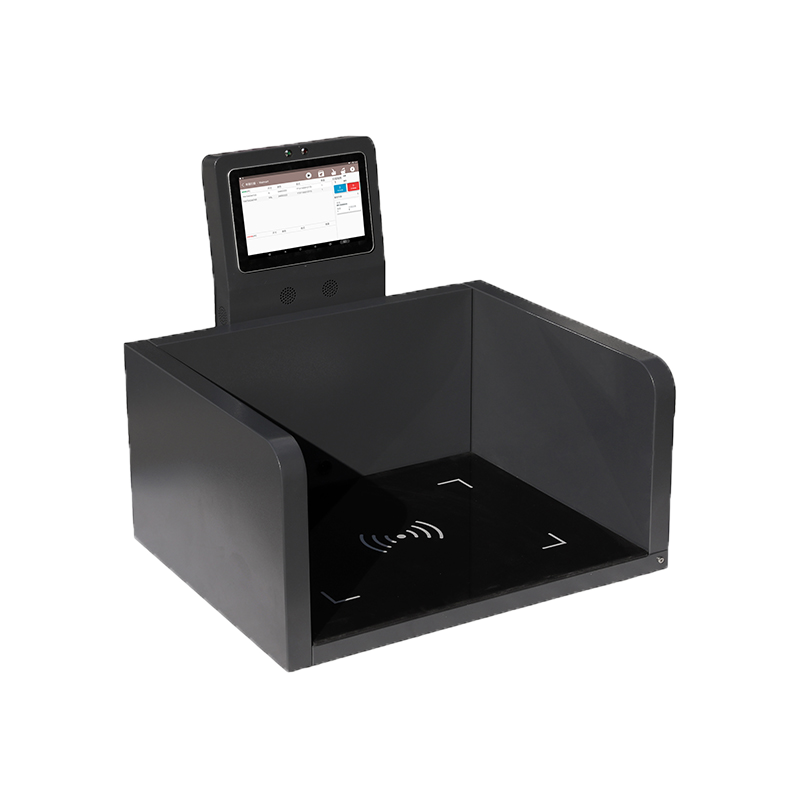
If your goal is not only to understand the RFID chip, but to build a working RFID system (tag + reader + antenna + integration), Syncotek maintains a full product catalog covering UHF modules, integrated readers, fixed readers, desktop readers, access gates, handheld RFID devices, antennas, and UHF tags.
A practical way to move faster is:
 Knowledge
In RFID systems, read means the reader detects a tag and retrieves data from its memory. Write means the reader changes data stored on the tag (for example, writing a new EPC or user data), sometimes followed by locking that data to prevent future changes. Most commercial RFID deployments use UHF (RAIN RFID) for longer range and fast bulk scanning. The core air-interface […]
READ MORE Uncategorized
RFID is no longer limited to experimental pilots or isolated warehouse projects. Large companies now use RFID to connect physical products, packages, credentials, vehicles, and customer interactions with digital business systems. Depending on the application, RFID can help a company identify an item, confirm its location, validate access, automate inventory counting, track movement, or trigger […]
READ MORE Knowledge
Reusable totes, bins, crates and returnable containers are easy to overlook because they are not usually the products being sold. But in many warehouses and manufacturing supply chains, they are valuable operational assets. A company may own 5,000 reusable totes and still struggle to answer basic questions: How many are currently available? How many are […]
READ MORE Knowledge
To read RFID means to use an RFID reader to detect a tag and retrieve data stored on it (an ID, EPC, UID, or user memory). With passive tags, the reader also provides the RF energy the tag needs to respond. The “how” depends on the RFID type: NFC / HF (13.56 MHz): very short-range […]
READ MORE Knowledge
Metal asset tracking is one of the most important applications in RFID, but it is also one of the most technically challenging. Many companies want to use RFID to identify tools, machines, containers, laptops, racks, returnable transport items, and industrial equipment, only to discover that standard RFID labels do not perform well when placed directly […]
READ MOREIf you are interested in our services or need customized solutions, please feel free to contact us.