
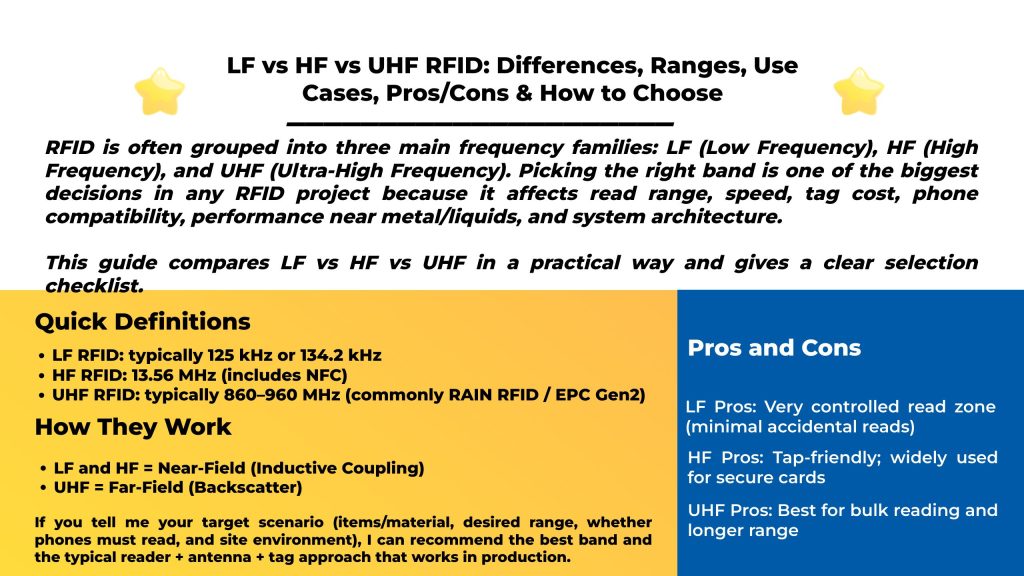
RFID is often grouped into three main frequency families: LF (Low Frequency), HF (High Frequency), and UHF (Ultra-High Frequency). Picking the right band is one of the biggest decisions in any RFID project because it affects read range, speed, tag cost, phone compatibility, performance near metal/liquids, and system architecture.
This guide compares LF vs HF vs UHF in a practical way and gives a clear selection checklist.
LF and HF use near-field magnetic coupling:
UHF (RAIN RFID) typically uses far-field backscatter:
| Feature | LF RFID | HF RFID (incl. NFC) | UHF RFID (RAIN) |
|---|---|---|---|
| Frequency | 125/134 kHz | 13.56 MHz | 860–960 MHz |
| Typical read range* | cm (very short) | cm (NFC ~0–4 cm); HF often up to ~10 cm, sometimes more | meters (often 1–10 m+; tuned conditions can be higher) |
| Read many tags at once | Limited/varies | Moderate | Excellent |
| Best strength | Controlled close reads; stability in harsh close-range scenarios | Tap UX, secure card ecosystem, phone compatibility (NFC) | Bulk inventory, automation, portals, logistics |
| Phone readable | No | Yes (NFC) | No |
| Tag cost at scale | Low–medium | Medium | Low for labels at volume |
| Typical deployments | animal ID, legacy access, industrial checkpoints | access control, ticketing, libraries, healthcare, NFC consumer interactions | warehousing, retail, manufacturing WIP, shipping/receiving |
| Common challenge | short range only | shorter range vs UHF; metal detuning | metal/liquid sensitivity; read-zone design |
*Real-world range depends on tag design, antenna, orientation, material, environment, and regulations.
Choose LF when you need:
Examples: animal ID, legacy access fobs, immobilizers, tool check stations.
Choose HF when you need:
Examples: access control badges, transit tickets, libraries, patient wristbands (workflow-dependent), NFC product engagement.
Choose UHF when you need:
Examples: warehouse receiving/shipping, retail cycle counts, manufacturing WIP, asset tracking at choke points, logistics sorting.
Buy UHF RFID Model : https://syncotek.com/products/uhf-module/
NFC is a subset of HF RFID at 13.56 MHz designed for very short-range, secure interactions—especially with smartphones.
There is no single best.
Generally no. Smartphones read NFC (HF), not UHF supply-chain tags.
Yes in most practical deployments, but UHF range can collapse with metal/liquids if tag/placement is wrong.
If you tell me your target scenario (items/material, desired range, whether phones must read, and site environment), I can recommend the best band and the typical reader + antenna + tag approach that works in production.
 Knowledge
What does OEM mean? OEM most commonly stands for Original Equipment Manufacturer. In business and manufacturing, an OEM is a company that makes a component, subsystem, or product that another company sells (often under its own brand)—or incorporates into a finished product sold to end customers. The key idea OEM describes a role in the supply chain: OEM (maker) → […]
READ MORE Knowledge
When people compare near-field vs far-field in RFID, they are really comparing two different ways energy and data move between the reader and the tag. In RFID, near-field systems are based on magnetic coupling and are typically associated with LF and HF/NFC, while far-field systems are based on radiated electromagnetic waves and backscatter and are typically associated with UHF RFID. That difference affects range, […]
READ MORE Knowledge
What Is Load Modulation? Load modulation is the uplink method used by most HF RFID and NFC tags to send data back to a reader in the near field. The tag does not generate its own RF carrier. Instead, it changes its electrical load across the tag coil, and that change is coupled back into the reader’s magnetic […]
READ MORE Knowledge
Rental businesses depend on the same assets moving repeatedly between warehouses, customers, job sites, service areas, vehicles, and return stations. This continuous movement creates a difficult inventory-management problem. A rental company may own the correct number of assets but still be unable to answer basic operational questions: Which items are available right now? Which customer […]
READ MORE Knowledge
Programming an RFID tag means writing useful data into the tag’s memory so that the tag can identify a product, carton, pallet, asset, tool, document, or other tracked item in an RFID system. Many RFID tags are supplied with pre-programmed data, but real projects often require custom encoding. For example, a business may need to […]
READ MOREIf you are interested in our services or need customized solutions, please feel free to contact us.