-
 Knowledge
Mar 19, 2026
Knowledge
Mar 19, 2026What Is Active RFID? A Complete Guide to Active RFID Tags, Readers, and Applications
Active RFID is a type of radio frequency identification technology that uses battery-powered tags to transmit data to RFID readers. Because the tag has its own power source, it can send signals over a much longer distance than a passive RFID tag, which relies on the reader’s signal for energy. That is why Active RFID is commonly […]
READ MORE -
Knowledge
Mar 18, 2026
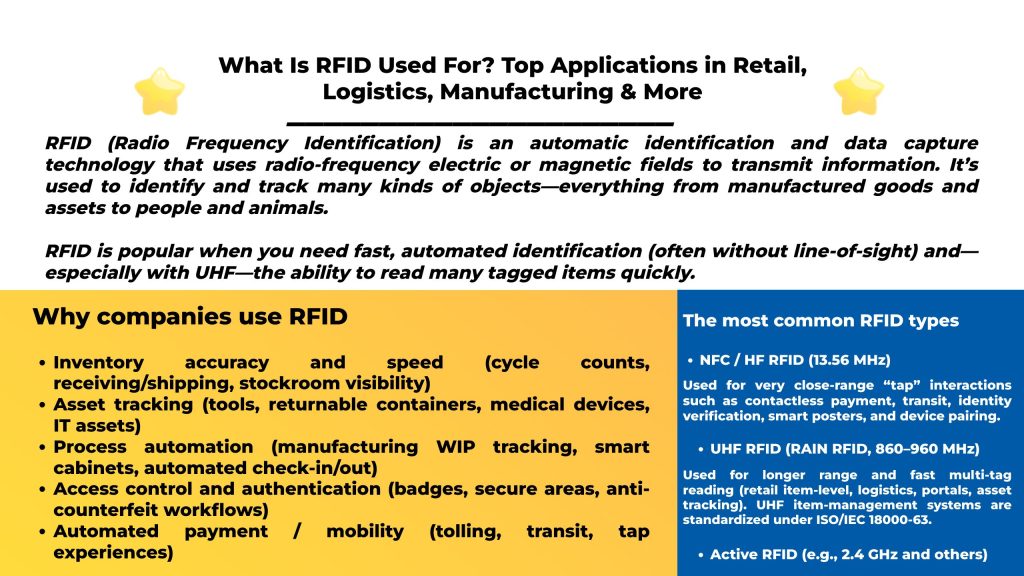
What Is RFID Used For?
RFID (Radio Frequency Identification) is an automatic identification and data capture technology that uses radio-frequency electric or magnetic fields to transmit information. It’s used to identify and track many kinds of objects—everything from manufactured goods and assets to people and animals. RFID is popular when you need fast, automated identification (often without line-of-sight) and—especially with UHF—the ability to […]
READ MORE -
Knowledge
Mar 14, 2026
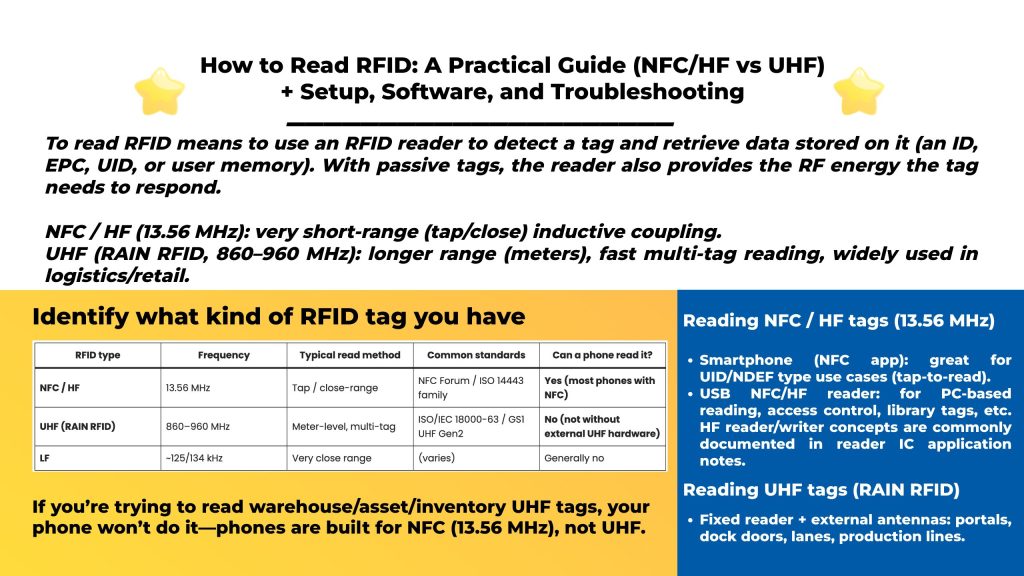
How to Read RFID: A Practical Guide (NFC/HF vs UHF) + Setup, Software, and Troubleshooting
To read RFID means to use an RFID reader to detect a tag and retrieve data stored on it (an ID, EPC, UID, or user memory). With passive tags, the reader also provides the RF energy the tag needs to respond. The “how” depends on the RFID type: Step 1: Identify what kind of RFID […]
READ MORE -
Knowledge
Mar 10, 2026
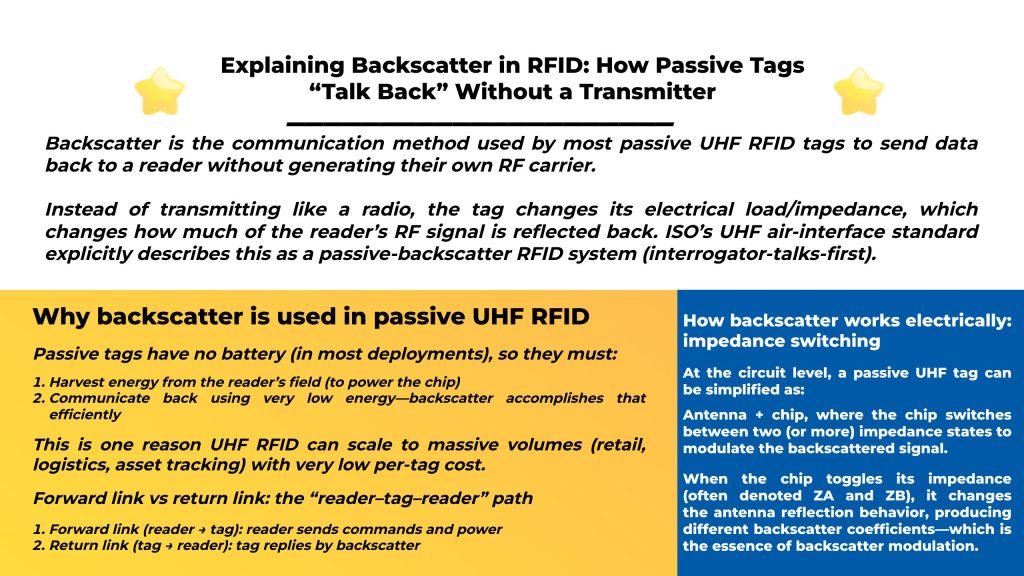
Explaining Backscatter in RFID: How Passive Tags “Talk Back” Without a Transmitter
What is backscatter (in RFID)? Backscatter is the communication method used by most passive UHF RFID tags to send data back to a reader without generating their own RF carrier. Instead of transmitting like a radio, the tag changes its electrical load/impedance, which changes how much of the reader’s RF signal is reflected back. ISO’s UHF air-interface standard explicitly describes this as a passive-backscatter RFID […]
READ MORE -
Knowledge
Mar 10, 2026
Load Modulation: The “Tag-to-Reader” Uplink in HF RFID & NFC
What is load modulation? Load modulation is the method most HF RFID (13.56 MHz) and NFC tags use to send data back to a reader in the near field. Instead of actively transmitting RF power, the tag switches an electrical load (often a resistor or transistor network) across its antenna coil. That change in tag current is coupled back through mutual inductance and becomes a […]
READ MORE -
Knowledge
Feb 26, 2026
LLRP / ALE / EPCIS: The RFID Software Standards That Turn Raw Reads Into Business Events
What are LLRP, ALE, and EPCIS (in one minute)? These three GS1/EPCglobal standards cover different layers of an RFID solution: A helpful mental model is: LLRP = control readers → ALE = filter/shape reads → EPCIS = share business events Where they fit in an RFID architecture GS1’s architecture discussions describe that when ALE and LLRP […]
READ MORE