
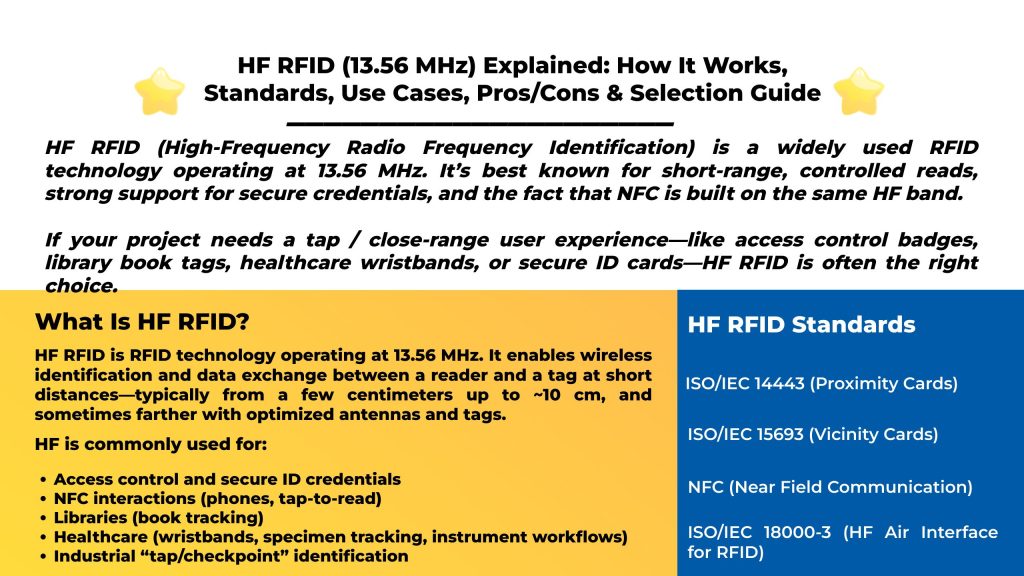
HF RFID (High-Frequency Radio Frequency Identification) is a widely used RFID technology operating at 13.56 MHz. It’s best known for short-range, controlled reads, strong support for secure credentials, and the fact that NFC is built on the same HF band.
If your project needs a tap / close-range user experience—like access control badges, library book tags, healthcare wristbands, or secure ID cards—HF RFID is often the right choice.
HF RFID is RFID technology operating at 13.56 MHz. It enables wireless identification and data exchange between a reader and a tag at short distances—typically from a few centimeters up to ~10 cm, and sometimes farther with optimized antennas and tags.
HF is commonly used for:
HF RFID uses near-field coupling (also called inductive coupling). Unlike UHF RFID, which typically relies on far-field backscatter, HF behaves more like a transformer:
Why this matters:
Near-field coupling naturally creates a short, controlled read zone, which is ideal for “tap here” interactions and reduces accidental reads.
Realted Read: Near-Field Coupling in RFID: What It Means, How It Works, and Why It Matters
HF RFID is a large ecosystem with multiple standards. The most common are:
Practical tip: Always confirm which standard your tags and readers must support. “HF RFID” alone is not specific enough for procurement.
HF RFID tags generally include a chip + coil antenna, packaged for the application.
Depends on tag type and standard. Many HF tags store:
HF antennas are typically coil-based. Antenna geometry directly influences:
NFC is built on HF RFID (13.56 MHz), but NFC adds interoperability requirements and common “modes” optimized for phones.
Rule of thumb:
More about RFID and NFC: HF vs NFC: Differences, Ranges, Security, Use Cases & Buying Guide
| Band | Frequency | Typical Strength | Best Fit |
|---|---|---|---|
| LF | 125/134 kHz | very controlled close reads, some harsh environments | animal ID, legacy tokens, close checkpoints |
| HF (incl. NFC) | 13.56 MHz | tap UX, secure credential ecosystem, phone compatibility (NFC) | access cards, libraries, healthcare, NFC taps |
| UHF (RAIN) | 860–960 MHz | long range, fast bulk reading | warehouse, logistics, retail inventory, portals |
If you need bulk inventory and meters of range, UHF is usually the right tool.
If you need tight control and “tap,” HF/NFC wins.
LF vs HF vs UHF RFID: Differences, Ranges, Use Cases, Pros/Cons & How to Choose
HF RFID security depends on tag type and system design:
Important: Short range helps, but short range alone is not a full security strategy.
HF tag families behave differently. Always validate:
HF RFID is 13.56 MHz RFID used for short-range “tap/close” identification—common in cards, keyfobs, libraries, healthcare, and NFC phone interactions.
NFC uses the HF band and is part of HF RFID, but NFC focuses on phone interoperability and very short-range interactions.
Usually not. Warehouses choose UHF because it can read many tags quickly at meter-level distances. HF is better for controlled close reads.
Often a few centimeters to ~10 cm in common tap-style setups; some optimized 15693 systems can reach farther, but HF remains “short-range” compared to UHF.
Metal can reduce performance unless you use ferrite backing, spacing, or tags designed for metal-adjacent mounting.
 Knowledge
Businesses often know how many assets they purchased but have much less visibility into where those assets are, who is using them, whether they are available, when they were last inspected, or whether they still exist. The problem appears across many industries. A manufacturer may need to manage thousands of tools and fixtures. An IT […]
READ MORE Uncategorized
RFID is no longer limited to experimental pilots or isolated warehouse projects. Large companies now use RFID to connect physical products, packages, credentials, vehicles, and customer interactions with digital business systems. Depending on the application, RFID can help a company identify an item, confirm its location, validate access, automate inventory counting, track movement, or trigger […]
READ MORE Knowledge
RFID (Radio Frequency Identification) is an automatic identification and data capture technology that uses radio-frequency electric or magnetic fields to transmit information. It’s used to identify and track many kinds of objects—everything from manufactured goods and assets to people and animals. RFID is popular when you need fast, automated identification (often without line-of-sight) and—especially with UHF—the ability to […]
READ MORE Knowledge
What Is Backscatter in RFID? Backscatter is the communication method used by most passive UHF RFID tags to send data back to a reader without generating their own RF carrier. Instead of transmitting like an active radio, the tag uses the reader’s signal as both its power source and its communication medium, then changes how that signal is […]
READ MORE Knowledge
Industrial laundries, hospitals, hotels, uniform rental companies, nursing facilities, and textile service providers process large volumes of garments and linens every day. These textile items move continuously between customers, collection points, sorting areas, washing machines, dryers, ironing systems, storage rooms, and distribution vehicles. Without reliable identification, it can be difficult to know how many items […]
READ MOREIf you are interested in our services or need customized solutions, please feel free to contact us.