
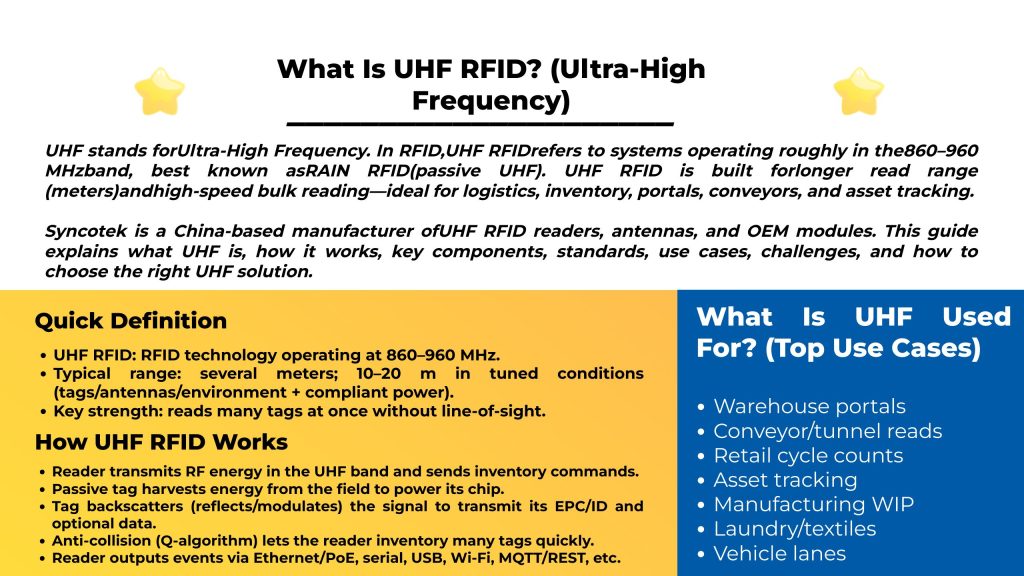
UHF stands for Ultra-High Frequency. In RFID, UHF RFID refers to systems operating roughly in the 860–960 MHz band, best known as RAIN RFID (passive UHF). UHF RFID is built for longer read range (meters) and high-speed bulk reading—ideal for logistics, inventory, portals, conveyors, and asset tracking.
Syncotek is a China-based manufacturer of UHF RFID readers, antennas, and OEM modules. This guide explains what UHF is, how it works, key components, standards, use cases, challenges, and how to choose the right UHF solution.
UHF RFID uses far-field backscatter:
| Band | Frequency | Typical Range* | Best For |
|---|---|---|---|
| LF | 125/134.2 kHz | up to ~10 cm | Animal ID, tools |
| HF / NFC | 13.56 MHz | tap to ~10 cm (14443); up to ~1 m (15693 optimized) | Access, tickets, libraries, phone taps |
| UHF (RAIN) | 860–960 MHz | meters; 10–20 m tuned | Logistics, inventory, portals, WIP |
| Active RFID | 433 MHz / 2.4 GHz | tens–hundreds of meters | RTLS, sensors, yard |
*Actual performance depends on tag type, antenna gain/pattern, orientation, materials (metal/liquids), and regional power limits.
Plus: coax cables, mounts, RF splitters (when needed), middleware, and apps.
Most modern passive UHF systems follow:
UHF bands and power rules differ by country:
Always set the correct region/country profile (channels + power) before testing or deployment.
How far can UHF RFID read?
Typically several meters; up to 10–20 m with tuned tags/antennas and compliant power.
Can phones read UHF tags?
No—phones read NFC (HF). For UHF you need a UHF handheld or Bluetooth/USB sled.
Is UHF RFID the same as RAIN RFID?
In most commercial contexts, yes—RAIN is the ecosystem name for passive UHF (ISO/IEC 18000-63 / EPC Gen2).
Does UHF work on metal?
Yes with the right on-metal tags and proper antenna/read-zone design.
Tell me: (1) region/country, (2) target range, (3) items/materials (metal/liquid?), (4) throughput speed (conveyor? forklift?), and (5) interfaces (PoE/serial/GPIO). I’ll propose a Syncotek-style UHF reader + antenna layout and a pilot checklist.
 Knowledge
The RFID system auto-identifies vehicles' weight, calculates net weight, and provides real-time monitoring for optimized efficiency.
READ MORE Knowledge
RFID—Radio Frequency Identification—is a wireless technology that identifies objects using radio waves. An RFID system can detect items without line-of-sight, often in bulk, and can automate tracking across warehouses, factories, retail stores, hospitals, and security systems. This guide explains what RFID is, how it works, RFID frequencies (LF/HF/NFC/UHF/RAIN), tags and readers, passive vs active vs […]
READ MORE Knowledge
UHF RFID systems use radio waves to communicate between readers, antennas, and passive RFID tags. In a small installation with one reader, radio-frequency interference may be relatively easy to control. In a warehouse, factory, retail store, distribution center, or event venue with several readers operating at the same time, the RF environment becomes more complicated. […]
READ MORE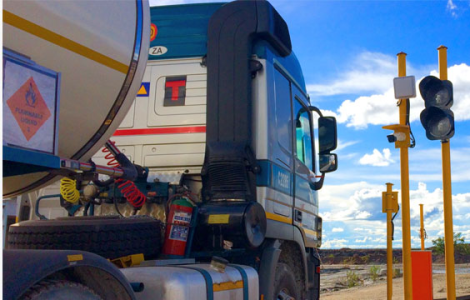 Case Show
The RFID system auto-identifies vehicles' weight, calculates net weight, and provides real-time monitoring for optimized efficiency.
READ MORE Knowledge
When businesses start planning an RFID project, they often focus on readers, antennas, and software first. However, one of the most important decisions is the RFID item attached to the object being tracked. This is where terminology can become confusing. Many people use RFID inlay, RFID tag, and RFID label interchangeably. In some conversations, this may not cause a […]
READ MOREIf you are interested in our services or need customized solutions, please feel free to contact us.